Wykład z serii Dream Chemistry Lecture z prof. Jürgenem Poppem (IPHT Jena, Niemcy)
Czas czytania: około 4 minuty
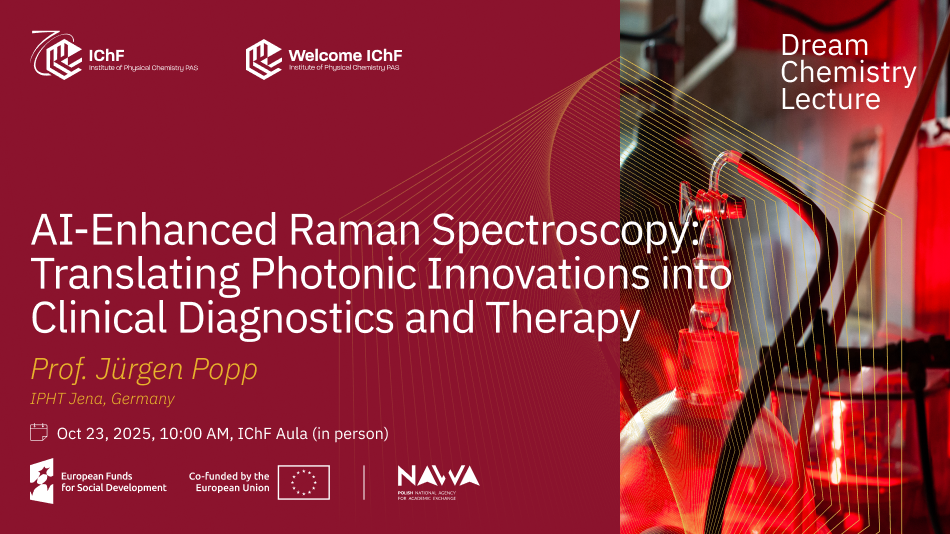
Serdecznie zapraszamy na kolejny wykład z cyklu Dream Chemistry Lecture w Instytucie Chemii Fizycznej Polskiej Akademii Nauk. Naszym gościem będzie prof. dr Jürgen Popp, dyrektor Leibniz Institute of Photonic Technology (IPHT) w Jenie (Niemcy) oraz kierownik Katedry Chemii Fizycznej na Uniwersytecie Fryderyka Schillera w Jenie.
Prof. Popp jest uznanym specjalistą w dziedzinie biofotoniki i spektroskopii molekularnej, szeroko rozpoznawalnym na arenie międzynarodowej za wprowadzanie najnowszych osiągnięć fotoniki do praktyki klinicznej.
Jego badania koncentrują się na opracowywaniu i zastosowaniach nowatorskich metod spektroskopowych w dokładnym obrazowaniu próbek chemicznych i biologicznych jak również w diagnostyce medycznej.
Tytuł wykładu: „AI-Enhanced Raman Spectroscopy: Translating Photonic Innovations into Clinical Diagnostics and Therapy”
Data: czwartek, 23 października 2025 r.
Godzina: 10:00 (CEST)
Miejsce: Aula IChF – seminarium stacjonarne, Instytut Chemii Fizycznej PAN, ul. Kasprzaka 44/52, 01-224 Warszawa
Abstrakt (w języku angielskim):
Raman spectroscopy has become a cornerstone of biophotonics, offering label-free molecular fingerprints with direct clinical relevance. Its convergence with artificial intelligence (AI) and complementary optical modalities is driving a paradigm shift from experimental method to clinically viable technology.
This presentation outlines our translational strategy along three representative examples. First, a high-throughput Raman blood analysis platform demonstrates how AI-based spectra interpretation enables rapid patient stratification, therapy monitoring, and culture-independent pathogen detection—essential for managing sepsis and antimicrobial resistance. Second, the regulatory-compliant Raman invaScope illustrates how real-time, AI-assisted endoscopic measurements support intraoperative tumor diagnostics, facilitating margin assessment in bladder as well as head and neck surgery. Third, multimodal endoscopic probes combine spontaneous and coherent Raman techniques with nonlinear optical imaging (SHG, TPEF) to generate morphochemical maps at subcellular resolution. Integrated with femtosecond-laser ablation, these probes open the path toward “seek-and-treat” workflows that unite diagnosis and therapy in a single system.
Underlying all approaches is a seamless diagnostic pipeline that spans sample preparation, spectral acquisition, and automated AI-based decision support. This integration minimizes operator dependency and enhances reproducibility, paving the way for robust deployment in diverse clinical settings.
We will conclude with an outlook on translational infrastructures and partnerships required to bring these Raman-based innovations into routine practice. Together, AI and advanced photonics are establishing Raman spectroscopy as a key enabler of intelligent, personalized healthcare.
Acknowledgment: Financial support from the EU, the Thüringer Ministerium für Bildung, Wissenschaft und Kultur, the Thüringer Aufbaubank, the Federal Ministry of Research, Technology and Space, the German Research Foundation, and the Carl-Zeiss Foundation is gratefully acknowledged.
Wybrane publikacje prelegenta:
W. Yang, F. Knorr, I. Latka, M. Vogt, G.O. Hofmann, J. Popp, I.W. Schie Real-time molecular imaging of near-surface tissue using Raman spectroscopy, Light Sci. Appl. 11, 90 (2022). DOI: 10.1038/s41377-022-00773-0
S. Guo, J. Popp, T. Bocklitz Chemometric Analysis in Raman Spectroscopy From Experimental Design to machine Learning–based Modeling, Nat. Protoc. 16, 5426-5459. (2021). DOI: 10.1038/s41596-021-00620-3
W. Zhu, E.-L. Cai, H.-Z. Li, P. Wang*, A.-G. Shen*, J. Popp, J.-M. Hu* Precise Encoding of Triple-Bond Raman Scattering of Single Polymer Nanoparticles for Multiplexed Imaging Application, Angew. Chem. Int. Ed. 60, 21846-21852 (2021). DOI: 10.1002/anie.202106136
E. Pshenay-Severin, H. Bae, K. Reichwald, G. Matz, J. Bierlich, J. Kobelke, A. Lorenz, A. Schwuchow, T. Meyer-Zedler, M. Schmitt, B. Messerschmidt*, J. Popp Multimodal Nonlinear Endomicroscopic Imaging Probe Using a Double-core Double-clad Fiber and Focus-combining Micro-optical Concept, Light Sci. Appl. 10, 207 (2021). DOI: 10.1038/s41377-021-00648-w
J. Meurer, J. Hniopek, T. Batz, S. Zechel, M. Enke, J. Vitz, M. Schmitt, J. Popp, M.D. Hager, U.S. Schubert Shape-memory Metallopolymers Based on Two Orthogonal Metal-ligand Interactions, Adv. Mater. 33, 2006655 (2021). DOI: 10.1002/adma.202006655
Wykład jest otwarty dla wszystkich zainteresowanych.
Działanie realizowane w ramach projektu pt.: ”WelcomeIChF: Wsparcie i Integracja Pracowników Zagranicznych w IChF PAN” (umowa nr BPI/WTP/2024/1/00020/U/00001), finansowanego przez Narodową Agencje Wymiany Akademickiej z programu „Welcome to Poland – nabór 2024”. Program Welcome to Poland finansowany jest ze środków Unii Europejskiej z Funduszu Europejskiego dla Rozwoju Społecznego 2021 – 2027 (FERS) w ramach projektu pt.: „Wsparcie instytucji szkolnictwa wyższego i nauki w obsłudze osób cudzoziemskich oraz Polek i Polaków wyjeżdżających za granicę”, nr FERS.01.05.IP.08-0003/24
- Data wpisu: 20.10.2025