Wykład w ramach cyklu Dream Chemistry Lecture: dr Kasra Amini (Max-Born-Institut, Berlin)
Czas czytania: około 3 minuty
Naszym prelegentem będzie dr Kasra Amini – kierownik grupy badawczej w Max-Born-Institut w Berlinie oraz główny wykonawca projektu TERES, finansowanego z grantu ERC Starting Grant (2024). Dr Amini uzyskał stopień doktora na Uniwersytecie Oksfordzkim, gdzie jego rozprawa została wyróżniona za wybitną jakość. W latach 2017–2021 prowadził badania w ICFO (Hiszpania), po czym w Berlinie Jego zespół prowadzi badania nad rozpraszaniem elektronów z rozdzielczością czasową i energetyczną, z wykorzystaniem technik takich jak RF-compressed UED oraz THz electron streaking. Jest autorem ponad 25 publikacji w prestiżowych międzynarodowych czasopismach, takich jak PNAS, Nature Communications, Optica, oraz redaktorem tomu RSC „Structural Dynamics with X-ray and Electron Scattering”. W 2020 roku otrzymał tytuł Emerging Leader, nadany przez czasopismo Journal of Physics B.
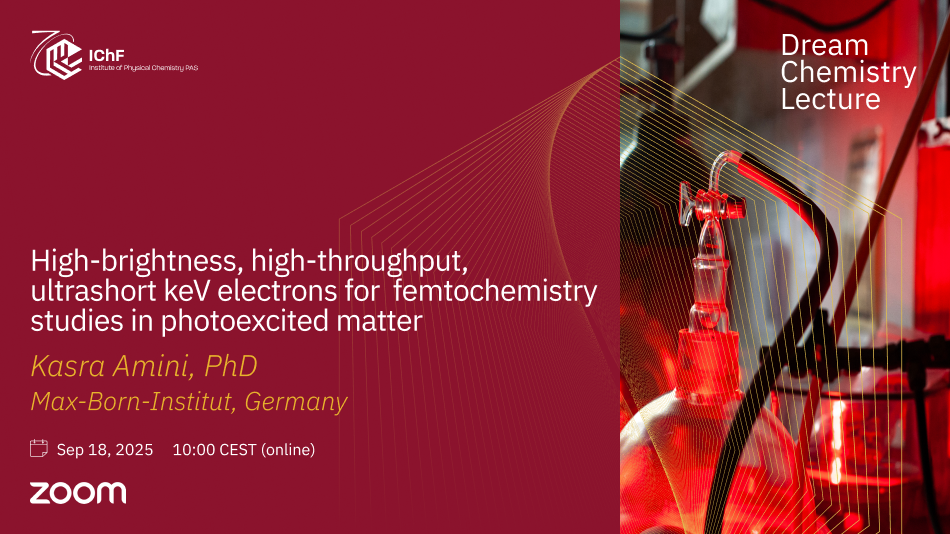
Tytuł wykładu: „High-brightness, high-throughput, ultrashort keV electrons for femtochemistry studies in photoexcited matter”
Data: czwartek, 18 września 2025 r.
Godzina: 10:00 (CEST)
Format: online na platformie Zoom
Link: https://zoom.us/j/94079507565?pwd=aqwJZYGCRch3aAYI0x5kQXAyvKRypz.1&
ID spotkania: 940 7950 7565
Kod dostępu: 577560
Abstrakt (w języku angielskim):
Since the pioneering work of Mourou [1] and Zewail [2], ultrafast electron diffraction (UED) has become the method of choice to study femtosecond structural dynamics in photoexcited matter, reaching picometre spatial and 100–240 fs temporal resolution in gas-phase and condensed systems [3–6]. Compact 100 keV UED instruments offer attractive simplicity and accessibility compared to facility-based MeV sources, but their performance is fundamentally constrained by space-charge effects [6]. For example, weakly relativistic 100 keV electron beams (0.55c) of high bunch charges (~20 fC) are often employed to achieve sufficient scattering signals at 1 kHz repetition rates, leading to space-charge broadening of electron pulses beyond the sub-picosecond regime. Even with radiofrequency (RF) [7] or THz compression [8], high-charge operation at 1 kHz limits pulse durations to ~150 fs, while single-electron operation at high repetition rate sacrifices throughput. Highly relativistic 3 MeV beams (0.99c) reduce space-charge effects by ~1,000 to achieve 29 fs compressed pulses [3], but their RF-driven accelerator source restricts it to 1 kHz operation, long beamlines (5-8 metres), indirect detection, and limited beamtime access.
We present a high-brightness, high-throughput 90 keV UED platform that overcomes these limitations. Using an RF compression cavity synchronized to the drive laser with <6 fs FWHM precision [9], we compress 0.4 - 7.4 ps electron pulses down to 91 - 114 fs, corresponding to a >65 compression factor, with charges ranging from 100 to 35,000 electrons per pulse, as confirmed with THz electron streaking [8]. Operating at 40 - 100 kHz with direct electron detection, our instrument combines femtosecond pulse durations with unprecedented throughput in the keV regime. Compared to state-of-the-art keV systems (>16 aC), our beam achieves shorter compressed durations (91 fs .vs. 100 - 150 fs) with higher brightness, while exceeding both keV and MeV UED in usable throughput by orders of magnitude.
In our recent work [10], we also detected time-resolved scattering signals with single-electron pulses and resolved electron-phonon dynamics in aluminium at 30 kHz using uncompressed beams. Here, we extend these capabilities into the high-charge regime via RF compression, combining high brightness (a per-pulse metric) with high throughput (a per-second metric). With high repetition rates, robust normalization to the measured unscattered beam, and direct detection, our instrument delivers among the brightest relativistic electron pulses and orders-of-magnitude higher usable throughput in the world, enabling high-sensitivity UED of gases, nanostructures, and photoinduced phase transitions.
References
[1] G. Mourou and S. Williamson, Appl. Phys. Lett. 41, 44–45 (1982).
[2] J. C. Williamson et al., Nature 386, 159–162 (1997).
[3] F. Qi et al., Phys. Rev. Lett. 124, 134803 (2020).
[4] X. Shen et al., Struct. Dyn. 6, 054305 (2019).
[5] T. Xiong et al., Phys. Rev. Res. 2, 043064 (2020).
[6] D. Filippetto et al., Rev. Mod. Phys. 94, 045004 (2022).
[7] T. van Oudheusden et al., Phys. Rev. Lett. 105, 264801 (2010).
[8] C. Kealhofer et al., Science 352, 429 (2016).
[9] M. R. Otto et al., Struct. Dyn. 4, 051101 (2017).
[10] F. R. Diaz et al., Struct. Dyn. 11, 054302 (2024).
Wydarzenie jest otwarte dla wszystkich zainteresowanych.
- Data wpisu: 16.09.2025