Nature-inspired novel route shaping nanocrystals
Reading time: about 5 minuts
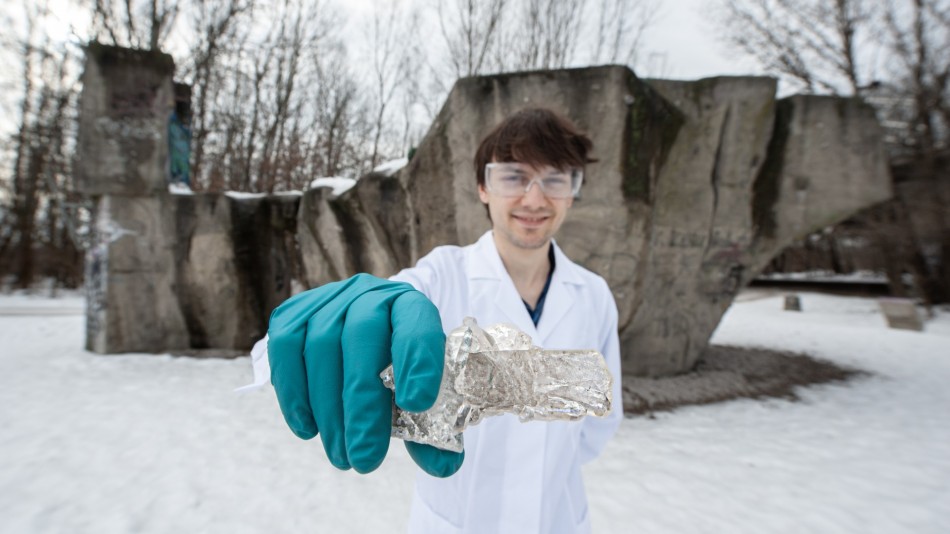
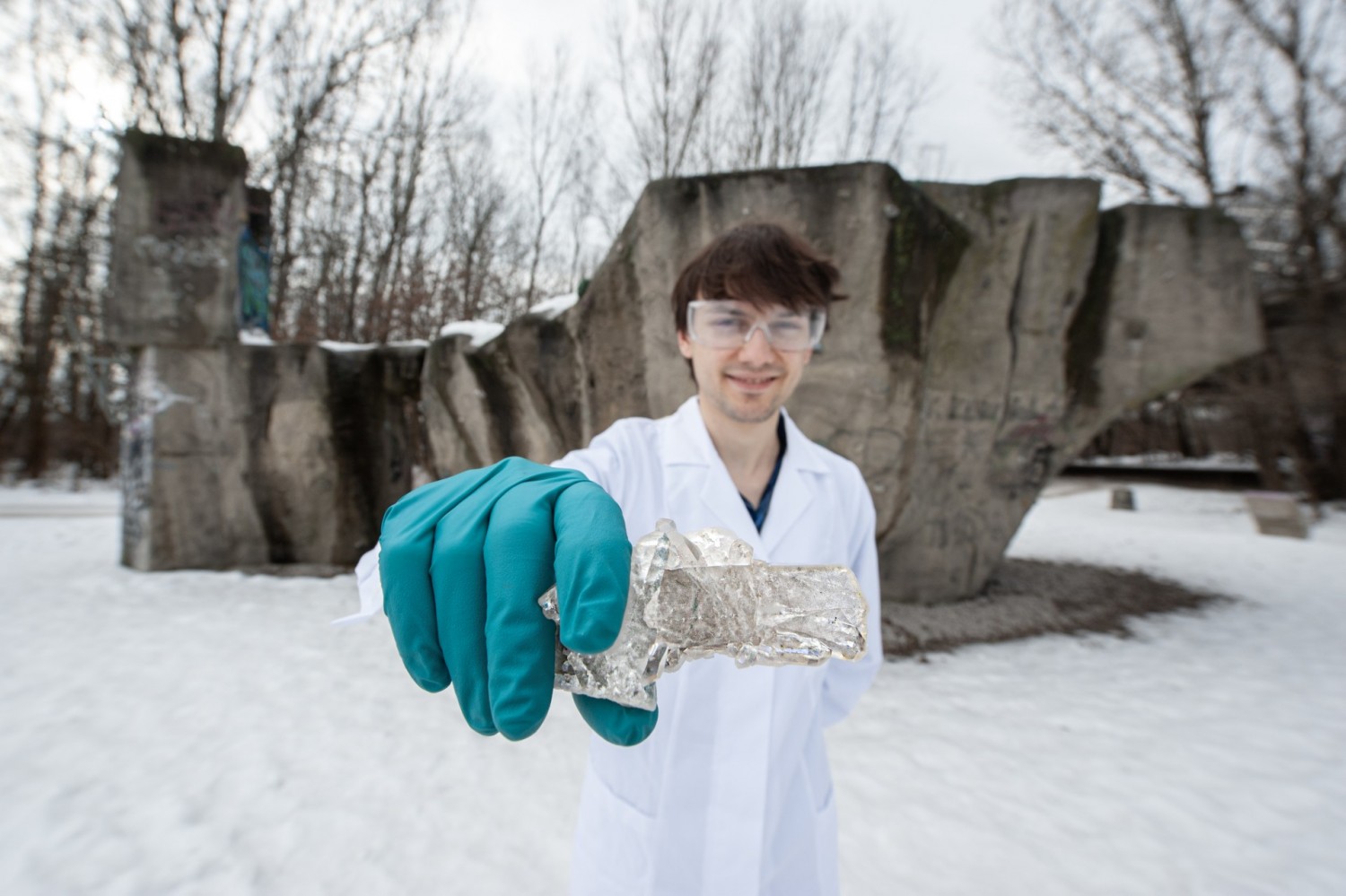
Nanosized crystals easily form in nature through chemical weathering, while their formation requires a long time. In contrast, laboratory solid-state synthesis enables their rapid formation under ambient conditions, provided that suitably predesigned molecular building blocks or crystal frameworks are employed. Still, the effectiveness of precise control of the nanocrystals formation on the molecular level is far from desired, making it a challenging riddle to be solved. Recent studies, demonstrated by researchers from the Institute of Physical Chemistry, Polish Academy of Sciences, and Warsaw University of Technology, led by Prof. Lewiński deliver a solution – a new route of transformation of molecular crystals to quantum dot monoliths.
In nature, tiny crystals known as nanocrystals are formed slowly over many years. Rocks and minerals react with air, water, and carbon dioxide in a process called chemical weathering. These reactions happen gently, at room temperature and normal pressure, gradually producing crystals so small they are invisible to the naked eye. Although slow, these natural processes create materials that are increasingly important in modern technologies, from electronics to medical devices. Reproducing this kind of crystal growth in the laboratory is much harder than it sounds. While nature has centuries to work, scientists need results in days. Laboratory methods often rely on high temperatures, strong chemicals, or complex procedures to control how crystals form and grow. Producing perfectly sized nanocrystals, especially inside solid materials , is particularly challenging.
Now, a team of researchers from the Institute of Physical Chemistry of the Polish Academy of Sciences and the Warsaw University of Technology, led by Prof. Janusz Lewiński, has developed a new approach inspired by nature. Their work, published in Nature Communications, shows that it is possible to mimic geological weathering, but on a tiny scale and in a much shorter time.
Instead of using harsh conditions, the researchers designed special molecular crystals that can react gently with moisture in the air. Their breakthrough all-solid-state method enables the growth of zinc oxide (ZnO) quantum dots directly inside a single crystal composed of molecular organozinc clusters of the type [RZn(X)]ₙ (where X is a monoanionic amidate ligand). The key lies in the intrinsic structure of these clusters: both the R–Zn and Zn–X bonds are susceptible to hydrolysis. When exposed to humid air, these crystals slowly transform from the inside. Water molecules trigger carefully controlled chemical reactions within the solid material, leading to the formation of extremely small ZnO particles known as quantum dots.
Remarkably, this process happens at room temperature and without any liquid solvents. Water molecules adsorb on the single-crystal surface and trigger controlled hydrolytic transformations. Then the reaction occurs in a hydrogen-bonded host organic matrix composed of hydrolysable organic ligands. The crystal itself acts like a tiny reaction chamber, guiding the growth of nanocrystals with great precision. Within just three to four days, uniformly sized zinc oxide quantum dots, about 4.5 nanometers across, form inside the original crystal.
“Although natural geological processes take years, they teach us how to design smarter materials. We can now recreate similar transformations in a controlled way, but on a much smaller scale and much faster,” explains Aleksandra Borkenhagen, a PhD candidate involved in the study.
Even more striking is that the outer shape of the crystal remains intact during the transformation. The material changes from within, without falling apart — much like rocks slowly weather in nature while keeping their overall form.
“By employing a variety of in situ spectroscopic and diffraction techniques, we demonstrated that exposure of a nonporous molecular single crystal to humid air results in the stepwise formation of low-dispersity quantum-sized semiconductor ZnO nanocrystals within three-four days. Strikingly, the multistep transformation proceeds without disrupting the overall crystal morphology, highlighting the critical role of crystal packing geometry and the hydrogen-bonded host organic matrix composed of hydrolysable amidate ligands in governing the reaction pathways.” adds Dr. Iwona Justyniak.
The team also showed that the newly formed nanocrystals can later be separated from the solid material under controlled conditions, providing access to clean, precisely sized quantum dots.
This nature-inspired method opens new possibilities for producing advanced nanomaterials in a simpler and more sustainable way. By learning from geology, scientists may be able to design next-generation materials for electronics, sensors, and energy technologies - without relying on extreme temperatures or harmful chemicals.
Sometimes, the best ideas come from simply watching how nature works.
CONTACT:
Prof. Janusz Lewiński
Institute of Physical Chemistry, Polish Academy of Sciences
email: Janusz.lewinski@pw.edu.pl
ARTICLE:
“Chemical weathering of molecular single crystals to monoliths of quantum dots”
Aleksandra Borkenhagen, Kamil Sokołowski, Paweł W. Majewski, Iwona Justyniak, Paula Roś, Anna M. Cieślak, Janusz Lewiński
Nature Communications volume 16, Article number: 10254 (2025)
DOI: https://doi.org/10.1038/s41467-025-65113-3
The activity is implemented as part of the project “WelcomeIChF: Support and Integration of Foreign Employees at the Institute of Physical Chemistry of the Polish Academy of Sciences” (contract no. BPI/WTP/2024/1/00020/U/00001), financed by the Polish National Agency for Academic Exchange (NAWA) under the “Welcome to Poland – 2024 call” programme. The “Welcome to Poland” programme is financed by the European Union through the European Funds for Social Development 2021–2027 (FERS), under the project “Support for higher education and science institutions in serving foreigners and Poles traveling abroad”, no. FERS.01.05.IP.08-0003/24.

- Author: own IChF materials
- Photo source: Grzegorz Krzyżewski
- Date: 19.02.2026