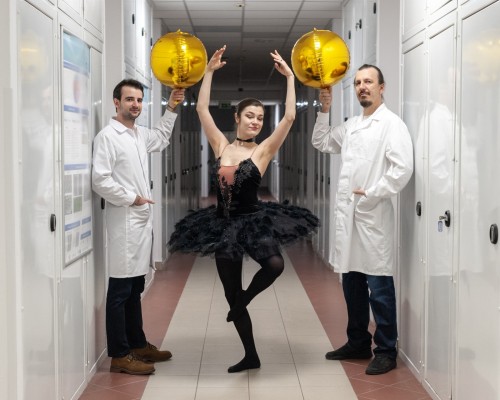
Stop the dancing! A new way to stabilize single-molecule in SERS
Reading time: about 7 minuts
The global development of civilization diseases is a challenge that requires many modern solutions, not only in terms of treatment, but first and foremost in terms of early diagnostics. One of the highly sensitive methods enabling fast identification of even ultralow concentrations of biomarkers or drugs in complex samples with high accuracy is Surface-Enhanced Raman Spectroscopy (SERS). However, despite many advantages, this method is still far from being used as a standard analytical method in biomedicine to detect a single molecule, mainly for the identification of disease entities. Recent work demonstrated by researchers from the Institute of Physical Chemistry, Polish Academy of Sciences address that issue, showing effective trapping of a single molecule enhancing the accuracy and precision in SERS detection. Their work open new horizons in this field. Let’s take a closer look at their breakthrough.
Molecular diagnostics is a powerful tool that enables the detection of many molecules that are linked to the development of many diseases. Starting from PCR tests that amplify DNA or RNA to detect infection or ELISA immunoassays that use antibodies to detect specific molecules, to mass spectrometry (MS) that identifies and precisely measures molecules in proteomics, metabolomics, and drug monitoring, to biosensors and optical techniques that identify proteins or cancer biomarkers in biological samples. Among these techniques, Surface-Enhanced Raman spectroscopy (SERS) plays an important role for enhanced sensitivity and real-time detection of disease markers, offering detection of “molecular fingerprint”, where fast detection and identification of certain molecules in ultralow concentration is enhanced by specially designed metal-based surfaces. Although SERS can detect even extremely low concentrations of chemical compounds that are crucial in early-stage disease diagnostics, achieving effective and reliable single-molecule detection is still challenging. One of the reasons relates to the molecular dynamics, where a single molecule change orientation onto the metal surface, leading to signal fluctuations and resulting in failed identification or detection. Once the molecule rotates or moves, the results can vary due to differences in the interaction between the substrates’ surfaces and the detected molecule, resulting in misinterpretation of the recorded spectra. It leads to the lack of common standards in comparing results between laboratories, making SERS despite its high sensitivity, still far from the analytical standard method in medical diagnostics. For this reason, much research focuses on developing standardized procedures, improving reliability, and validating results, to make SERS a real-time diagnostic method for clinical applications.
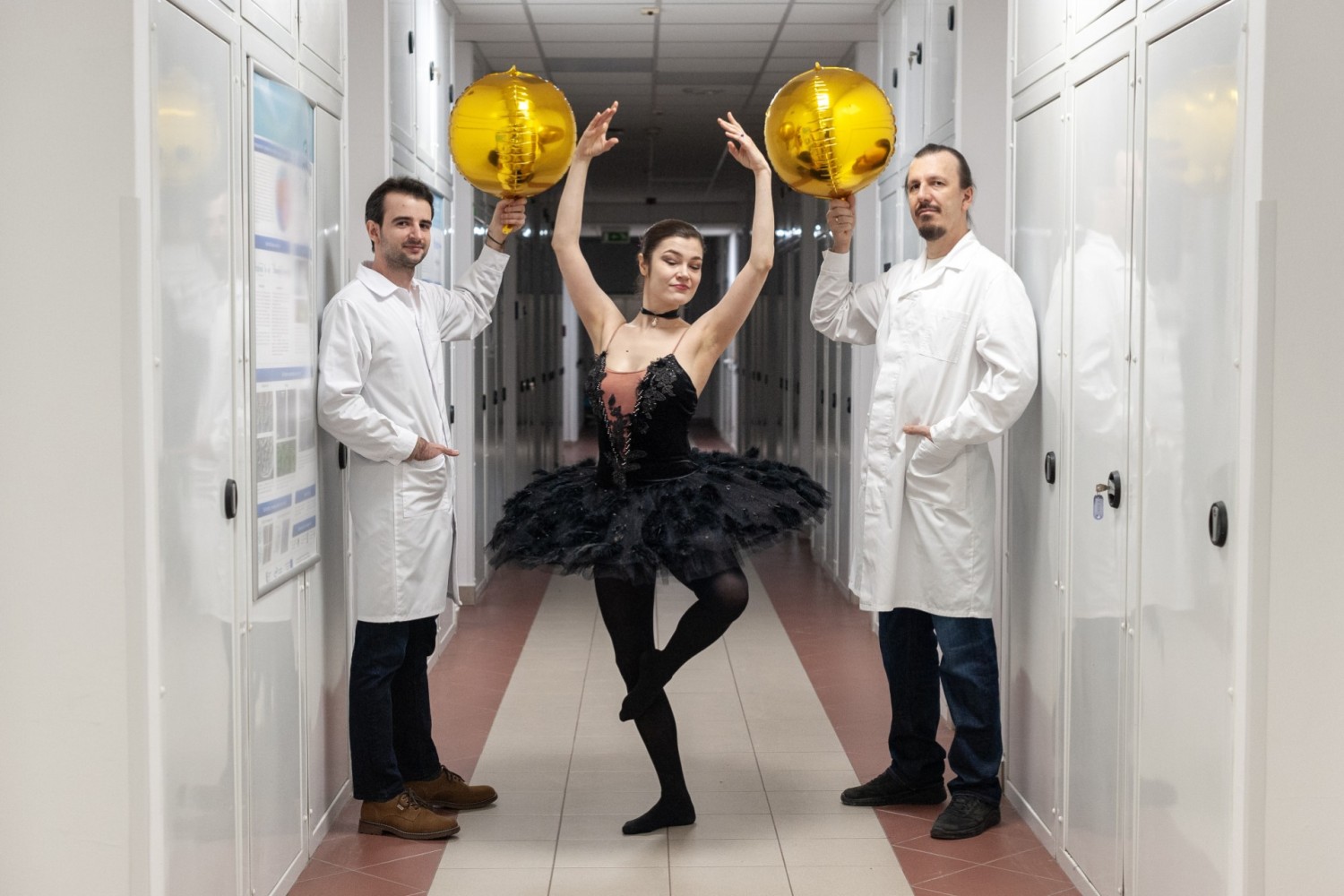
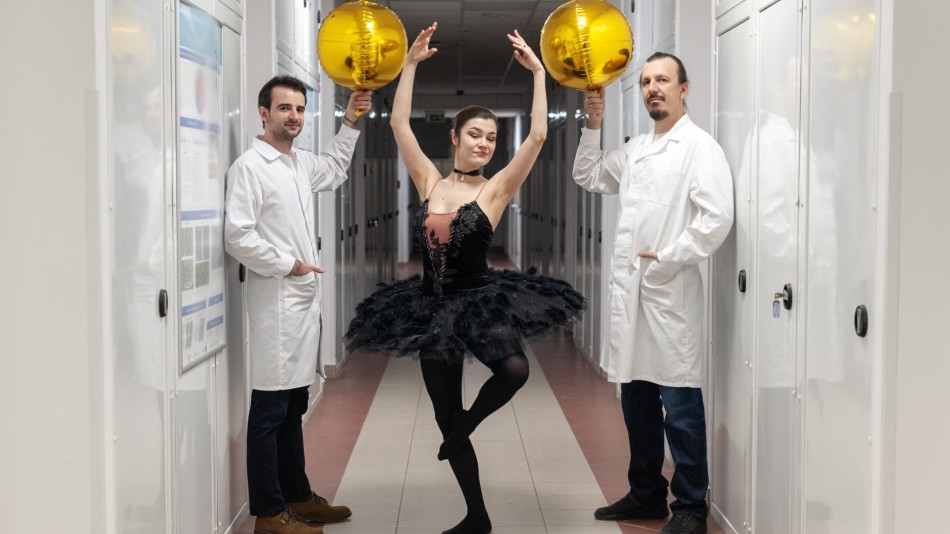
Facing this issue, Patryk Pyrcz and Sylwester Gawinkowski – researchers from the Institute of Physical Chemistry, Polish Academy of Sciences (IPC PAS) in Poland presented the new approach in SERS methodology that catches a “dancing” molecule in a molecular trap. All towards faster, more effective, and reliable single-molecule detection. Their approach is based on an understanding of the single molecule behavior in the close neighborhood of plasmonic substrates like gold or silver nanoparticles. Why do these interactions matter? SERS identification of chemicals relies on light scattering by the vibrating molecule. For many molecules that are present in the analyzed sample, the signal from their position changes is averaged, enabling precise detection and identification. However, the single-molecule identification is a different story. The molecule changing its orientation during measurement exposes dynamically certain functional groups resulting in an enhanced signal for the particular vibration in the molecule. Therefore, the signal for the molecule's current position may result in a misinterpretation. Researchers from IPC PAS propose the novel solution by entrapping of “dancing” molecule in the pumpkin-shaped macrocyclic molecule, called curcubit[7]uril (CB[7]).
Once the single molecule is immobilized in the supramolecular complex, its signal in SERS is clear, excluding random fluctuations that would disturb the recorded spectrum. CB[7] has attracted the attention of researchers due to its unique barrel-shaped structure and the specific properties of its internal cavity, which enable the binding of various molecules, so-called guests. In the case of CB[7], the hydrophobic effect arises from the expulsion of high-energy water molecules from its nonpolar cavity upon binding of the guest molecule, thereby making complexation thermodynamically favorable. An additional advantage of CB[7] is the presence of carbonyl groups on both sides of CB[7], which ensures the formation of a stable interaction with metallic nanoparticles.This unique combination of the CB[7] structure and position of functional groups makes it highly attractive for SERS applications, improving the accuracy and reproducibility of recorded spectra.
“The supramolecular encapsulation within CB[7] provides effective physical confinement without chemical modification of the target molecule, offering a promising alternative to traditional covalent anchoring approaches that often alter molecular properties. The mechanism involves CB[7] acting as a molecular ″cage″ that restricts translational motion of the guest molecule, leading to several interconnected effects that collectively improve SM-SERS performance” – says Patryk Pyrcz.
The effect was presented by using thionine (Th), which is a commonly known dye widely used for biological staining, where, in addition to the experimental studies, the complementary DFT simulations delivered fundamental insight into molecule–cavity in CB[7] interactions in both aqueous media and dry conditions. For the free Th molecules, the signal is disturbed by sudden intensity changes, while Th–CB[7] complexes result in much more stable SERS responses over time, which is an effect of reduced Th fluctuations. Importantly, the effect was confirmed on two models: a mirror-like surface and an oligomer cluster made of plasmonic gold nanoparticles.
“Our results demonstrate that CB[7] encapsulation improves the reliability of SM-SERS detection by reducing amplitude fluctuations. Under electronic-resonant excitation of the analyte, detection probability increases owing to the CB[7]-enforced optimal alignment of Th’s transition dipole moment with the nanocavity’s electromagnetic field. As a result, the Raman process occurs more efficiently compared to molecules freely oriented on the metal surface, which is reflected in the more dynamic decay of the SERS signal in the case of Th-CB[7]. “ – remarks dr. Sylwester Gawinkowski.
Demonstrated findings are a step forward in the fundamental understanding and development of stabilized single-molecule SERS towards practical applications. Authors highlight an importance or curiosity and interdisciplinary approach in their studies, and emphasize the significance of studies on different supramolecular hosting structures to optimize the balance between stabilization of the guest molecule fluctuations and signal enhancement, focusing not only on simple dye-like molecules but also biomarkers that could be detected in metabolites. Controlled manipulation of single-molecule dynamics using supramolecular chemistry is a milestone in reaching robust and reliable analytical data, bringing us closer to the much cheaper, faster, and sensitive detection of biomarkers in the future.
Their work published in ACS Physical Chemistry Au journal was supported with “Diamond Grant” program, grant number 0047/DIA/2020/49 and by National Science Centre, Poland, grant number 2020/39/B/ST4/01523.
CONTACT:
Dr. Sylwester Gawinkowski
Institute of Physical Chemistry, Polish Academy of Sciences
email: sgawinkowski@ichf.edu.pl
ARTICLE:
“Supramolecular Stabilization of Single-Molecule SERS: Cucurbit[7]uril Encapsulation of Thionine”
Patryk Pyrcz and Sylwester Gawinkowski
ACS Physical Chemistry Au, 2026 6 (1), 57-68
DOI: https://doi.org/10.1021/acsphyschemau.5c00076
The activity is implemented as part of the project “WelcomeIChF: Support and Integration of Foreign Employees at the Institute of Physical Chemistry of the Polish Academy of Sciences” (contract no. BPI/WTP/2024/1/00020/U/00001), financed by the Polish National Agency for Academic Exchange (NAWA) under the “Welcome to Poland – 2024 call” programme. The “Welcome to Poland” programme is financed by the European Union through the European Funds for Social Development 2021–2027 (FERS), under the project “Support for higher education and science institutions in serving foreigners and Poles traveling abroad”, no. FERS.01.05.IP.08-0003/24.

- Author: Dr Magdalena Osial
- Contact: magdalena@osial.eu
- Photo source: Grzegorz Krzyżewski
- Date: 9.02.2026