One exam, the whole retina. ICTER scientists seek to simplify eye imaging
Reading time: about 10 minuts
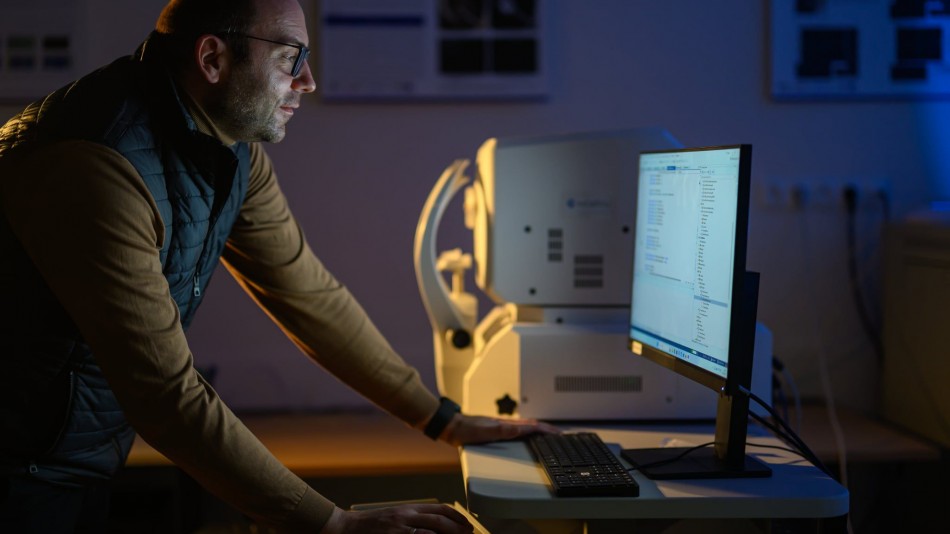
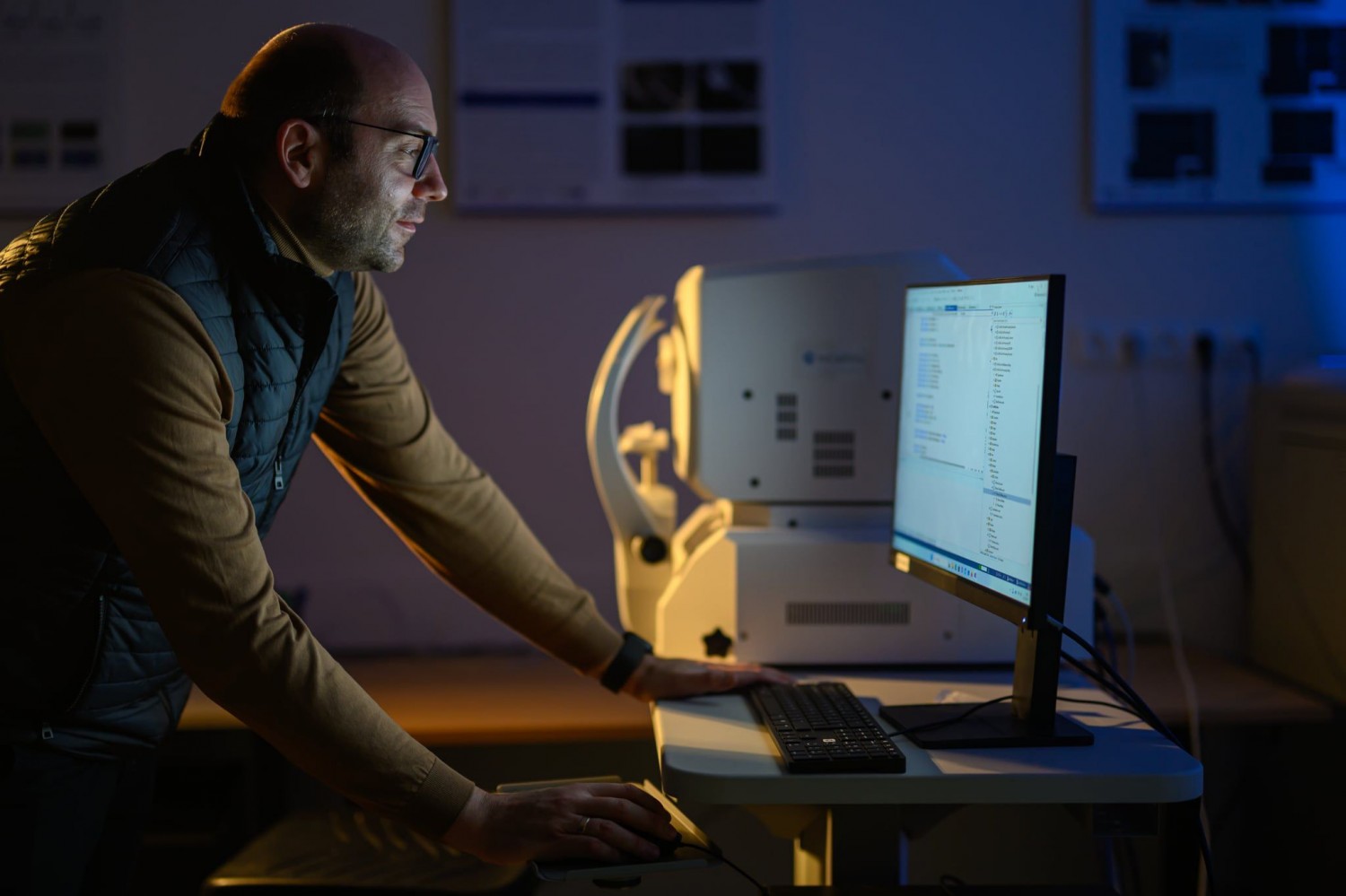
A new method developed with the participation of ICTER researchers indicates that, in retinal imaging, less may mean more - fewer settings, fewer complications, and more information.
The more precisely we want to examine the human retina, the more clearly one of the fundamental limits of physics becomes apparent. In cellular-resolution eye imaging, the same trade-off has applied for years - tiny structures can be seen with impressive sharpness, but only within a very thin layer of tissue. To view the entire retina, researchers usually have to refocus and acquire several separate scans in a repetitive manner. An international team led by Dawid Borycki and Maciej Wojtkowski from ICTER, together with Zhuolin Liu and Daniel X. Hammer from the FDA Center for Devices and Radiological Health (CDRH), has now shown that this limitation can potentially be overcome.
Rather than making the hardware even more complex, the researchers combined optical and computational procedures. This is an important step not only for advancing imaging physics, but also for potentially improving the diagnosis of eye diseases and neurological disorders. The details are described in the article, “Computational aberration correction enables full-thickness retinal imaging with adaptive optics optical coherence tomography,” published in Biocybernetics and Biomedical Engineering.
The greater the precision, the harder the exam
Today’s retinal-imaging methods are sensitive enough to reveal structures at the level of single cells. This ability is a major opportunity for medicine, because the retina is one of the very few parts of the nervous system that can be examined non-invasively through the transparent structures of the eye. Its microstructure can reveal not only ophthalmic diseases, such as age-related macular degeneration (AMD) or diabetic retinopathy, but also systemic and neurodegenerative disorders. Eye imaging is becoming an increasingly important tool for detecting pathology early and monitoring how the disease progresses.
The challenge occurs when we want to examine “too much” simultaneously. The higher the resolution, the narrower the range over which the image remains sharp; i.e., the so-called depth of focus is limited. In practice, an instrument can focus perfectly on one retinal layer, while layers lying slightly closer to or farther from the imaging plane begin to blur. This limitation means that if we want to visualize the whole retina clearly, from its inner layers down to the photoreceptors, we usually need to acquire several separate measurements at different focus settings and then digitally stitch them together. This sequential process lengthens the exam, makes the entire procedure more complex, and increases the risk of artifacts caused, for example, by tiny eye movements. This complexity is exactly the problem the team was seeking to address in its research.
AO-OCT: looking deep into the retina at single-cell resolution
A central role in this study is played by AO-OCT, optical coherence tomography combined with adaptive optics, developed in Dr. Hammer’s group at CDRH. It brings together two technologies. OCT is a well-established technique in ophthalmology, essentially the optical equivalent of ultrasound, using infrared light rather than sound, and with much higher precision. AO is a technique that enhances the OCT image by correcting optical distortions introduced by the eye itself and the imaging optics. Thanks to this correction, image sharpness can be greatly improved, approaching the physical limits of optical performance. The result is remarkable.
AO-OCT can generate three-dimensional retinal images of the living eye with cellular resolution. It makes it possible to visualize photoreceptors, some transparent neurons such as retinal ganglion cells, capillaries, and many other tiny structures that, until recently, were beyond the reach of non-invasive imaging. That is why AO-OCT is considered one of the most advanced and promising techniques in modern ophthalmic diagnostics and retinal research. However, the high resolution of AO-OCT comes at a price.
The high numerical aperture used in AO-OCT limits the depth of focus to just a few tens of micrometers. That depth range is very limited when we consider that the retina is a multilayered tissue spanning approximately 300 micrometers and, from both biological and clinical perspectives, we often want to observe structures located at different depths at the same time, as is done with conventional OCT. This issue, among others, has limited clinical translation and prevented more widespread use of AO-OCT, denying clinicians a more detailed view of their patient’s eye diseases. Accordingly, researchers have been searching for ways to “stretch” the range of sharp imaging without sacrificing high resolution.
How can the whole retina be seen without constantly refocusing?
Researchers from ICTER and the CDRH were committed to addressing the challenge of how they could see the whole retina clearly without acquiring multiple separate scans at different depths. To date, the only solution has been so-called focus stitching. In practice, this approach involves consecutively focusing first on one layer, then on another, and another, etc.; and finally registering, aligning, and combining all the acquired images into a single volume. Such combinatorial imaging works, but it is expensive both in terms of hardware and time commitment. A costly and time-intensive technique may be valuable in experimental research, but it is not practical for clinical applications, so developing a means to simplify the entire procedure could be beneficial.
The authors proposed to study a hybrid approach, whereby the adaptive optics hardware corrects the eye’s main aberrations and ensures high-quality input data for the multiple layers of the eye simultaneously, and the overall data are processed by the so-called Computational Aberration Correction (CAC) algorithm for extending the depth of focus.
“In this study, we focused primarily on correcting depth-dependent defocus - in other words, the kind of blur that arises because different retinal layers do not lie in the same focal plane. If the instrument is perfectly focused on one layer, the sharpness of the other layers becomes suboptimal. The CAC algorithm is designed to recover the sharpness of those layers that were not located at the best focal position during acquisition,” said Dr. hab. Dawid Borycki, head of the PICO Group at ICTER and first author of the publication.
This is not a simple beautifying filter, nor is it a digital trick that “adds” missing details. Computational correction works only because the necessary phase and amplitude information is already present in the input data. The algorithm reorganizes and recalculates that information to restore sharpness in structures located outside the original focal plane. In other words, it does not create a new signal - it makes more complete use of the signal that has already been recorded. That is why high-quality input data remains crucial.
Not every blur can be fixed computationally
Computational correction does not work in a vacuum. If the signal from a given layer is too weak, the algorithm has nothing to recover. The study showed that an adequately high signal-to-noise ratio is essential for effective correction. Empirically, the usability threshold turned out to be about 25 dB. Below that level, the computer-based correction can no longer reliably estimate the required phase parameters, and the improvement in image quality becomes clearly limited.
“High-resolution adaptive optics imaging features a very narrow depth of focus, with energy dispersing rapidly outside the focal region. The concept here is that with an appropriately chosen focus setting, details from multiple retinal layers can be recovered computationally, eliminating the need for several separate acquisitions,” said Dr. Zhuolin Liu, Senior Staff Fellow, Center for Devices and Radiological Health, FDA.
The ability to use a single focus would have practical implications. Importantly, the focus cannot simply be set anywhere with the expectation that the computer will do the rest. A particular focal position has to be found at which the signal from different parts of the retina remains good enough for the algorithm to work effectively. Finding the “sweet spot” was one of the most important elements of the study.
Two eyes, different conditions, one goal
The experiments were carried out at the CDRH, where data were collected from two volunteers: a healthy 39-year-old and a 53-year-old with multiple sclerosis (MS) and a history of optic neuritis. This choice was deliberate. The researchers wanted to test how the method performs both in a healthy retina and in an eye already affected by disease-related changes. The comparison allowed them to assess not only the imaging quality itself, but also whether the approach could be translated to future clinical diagnostics. MS typically affects the optic nerve head and retinal ganglion cells in the inner retina, but less is known about how the disease affects photoreceptors cells (cones and rods), in the outer retina. AO-OCT plus CAC now enables the examination of both layers simultaneously.
Imaging was performed at several distances from the center of the retinal macula (fovea). This is important because imaging conditions change with distance from the fovea. The closer one gets to the fovea, the more densely packed the photoreceptors are and the harder they are to distinguish from one another. Furthermore, retinal thickness reaches its maximum in the parafoveal region, presenting the greatest challenge for computational depth-of-focus extension algorithms. If the method works even for these challenging regions, that is a strong indication of its real value.
The authors examined what happens when the focus was set, in turn, to different retinal layers: the ganglion cell layer, the inner plexiform layer, and the photoreceptor layer. CAC was then applied to these data in each case to determine how well the sharpness could be recovered in the remaining layers. Neither a focus on the deepest layers containing the photoreceptors nor on the most internal neuronal layers yielded effective broad-depth resolution.
The best multi-layer resolution was achieved by focusing on the inner plexiform layer (IPL) near the middle of the retina. From this position, the signal remained high enough both for structures located deeper in the retina and for those closer to the interior of the eye, allowing CAC to restore sharpness in both directions. With this setting, the signal-to-noise ratio in the retinal layers remained at about 33-39 dB, well above the threshold needed for effective correction. At present, this correction takes about 3.4 seconds per scan. The authors note, however, that by using GPU acceleration, this time might be reduced to milliseconds.
“We are working to develop new scientific approaches to address long-standing challenges with adaptive optics that have stunted adoption of this important imaging technology. Our research priority was not only to improve image quality, but also to simplify the entire patient examination. If reliable information across the full thickness of the retina can be obtained from a single focus setting, it could potentially enable more practical and clinically useful cellular-resolution eye imaging,” said Dr. Daniel Hammer, Deputy Director of the Division of Biomedical Physics Deputy Director, Center for Devices and Radiological Health, FDA.
What does this mean for the patient?
Although this publication deals with a highly advanced imaging technique, its researchvalue is simple. The goal is to make detailed retinal examinations faster, smoother, and less dependent on repeated acquisitions. For patients, achieving this goal could eventually mean a visit that is 3-5 times shorter than today’s more complex research procedures. The shorter and simpler the exam, the lower the risk that the image will be degraded by natural eye movements, fatigue, or difficulty maintaining steady fixation.
From a medical perspective, obtaining high-resolution images of the eye is very important because, for diagnosing retinal diseases as well as some neurological disorders, not only detecting advanced changes, but also capturing the earliest, subtle signs of damage, can be important. If physicians can obtain a highly detailed image of the whole retina more quickly, their chances increase of making earlier diagnoses and monitoring disease progression more accurately.
------------------------------------------------------------------------------------------------
Dawid Borycki, Zhuolin Liu, Daniel X. Hammer, Maciej Wojtkowski (2025). Computational aberration correction enables full-thickness retinal imaging with adaptive optics optical coherence tomography. Biocybernetics and Biomedical Engineering.
DOI: https://doi.org/10.1016/j.bbe.2026.02.002
Author: Scientific Editor Marcin Powęska
- Author: Scientific Editor Marcin Powęska
- Photo source: Karol Karnowski
- Date: 20.04.2026