How to see the invisible? The limits of two-photon vision
Reading time: about 6 minuts
Near-infrared light is invisible to humans. And yet, under the right conditions, the human eye can perceive it. Researchers from the International Centre for Translational Eye Research (ICTER) have now shown that the efficiency of this phenomenon depends not only on the laser pulse itself, but also on two highly specific factors: the beam diameter and the precise focusing of light on the retina.
In everyday life, we see visible light - wavelengths detected by the photoreceptors of the retina. Near-infrared light lies outside this range, which is why it normally remains invisible to us. However, for several years, scientists have known of an exception.
This exception is known as two-photon vision. In this phenomenon, a photopigment in the retina absorbs two infrared photons almost simultaneously. Each photon individually carries too little energy to trigger visual perception, but together they can initiate the process of vision. This is why, under certain conditions, humans can "see" radiation that theoretically should remain invisible.
This mechanism differs from normal vision in a more subtle way as well. In two-photon vision, not only the amount of light matter, but also how precisely it is focused. The greater the local light intensity, the higher the probability that two photons will be absorbed nearly at the same moment. This makes the entire process far more sensitive to the optical properties of the stimulating beam than classical vision.
What exactly did the researchers study?
The study, published in Optics Letters under the title "The effect of laser-beam diameter on the visibility of two-photon stimuli," was conducted by Agnieszka Zielińska, Daniel Rumiński, Maciej Szkulmowski, Maciej Wojtkowski, and Katarzyna Komar. The researchers wanted to determine how the diameter of a laser beam influences the visibility threshold of two-photon stimuli and how important precise focusing is in this process.
This question is important not only from the perspective of the physics of two-photon vision itself. The answer also affects how future devices based on this phenomenon should be designed, including retinal imaging systems and potential next-generation displays using two-photon visual perception. The authors also compared two-photon stimuli with classical single-photon vision to better understand what fundamentally distinguishes the two processes.
The experiment used two types of light: infrared light with a wavelength of 1040 nm and visible light at 520 nm. Interestingly, both stimuli were perceived by participants as green. This alone illustrates how counterintuitive two-photon vision can be.
How was the experiment conducted?
The study involved three healthy volunteers. Measurements were performed in the preferred eye, with dilated pupils and accommodation blocked - meaning the eye’s natural ability to adjust focus was disabled. Before the actual measurements, the optical setup was individually adjusted for each participant to determine the point of best focus.
The researchers then investigated how the visibility threshold changed under different levels of defocus, both in dark and illuminated conditions. Stimuli were displayed in the center of the retina and 5 degrees away from the center. They appeared as a small flickering ring, similar to stimuli used in standard visual field testing. The experiment complied with laser safety standards and received approval from a bioethics committee.
This was an extremely precise experiment. The beam diameter was altered by exchanging optical lenses, while defocus was introduced by shifting one of the optical components. In bright conditions, a green LED served as background illumination. Rather than a simple “can you see it?” test, the study was a carefully controlled psychophysical experiment designed to isolate the influence of different optical parameters on visual thresholds.
What did the results show?
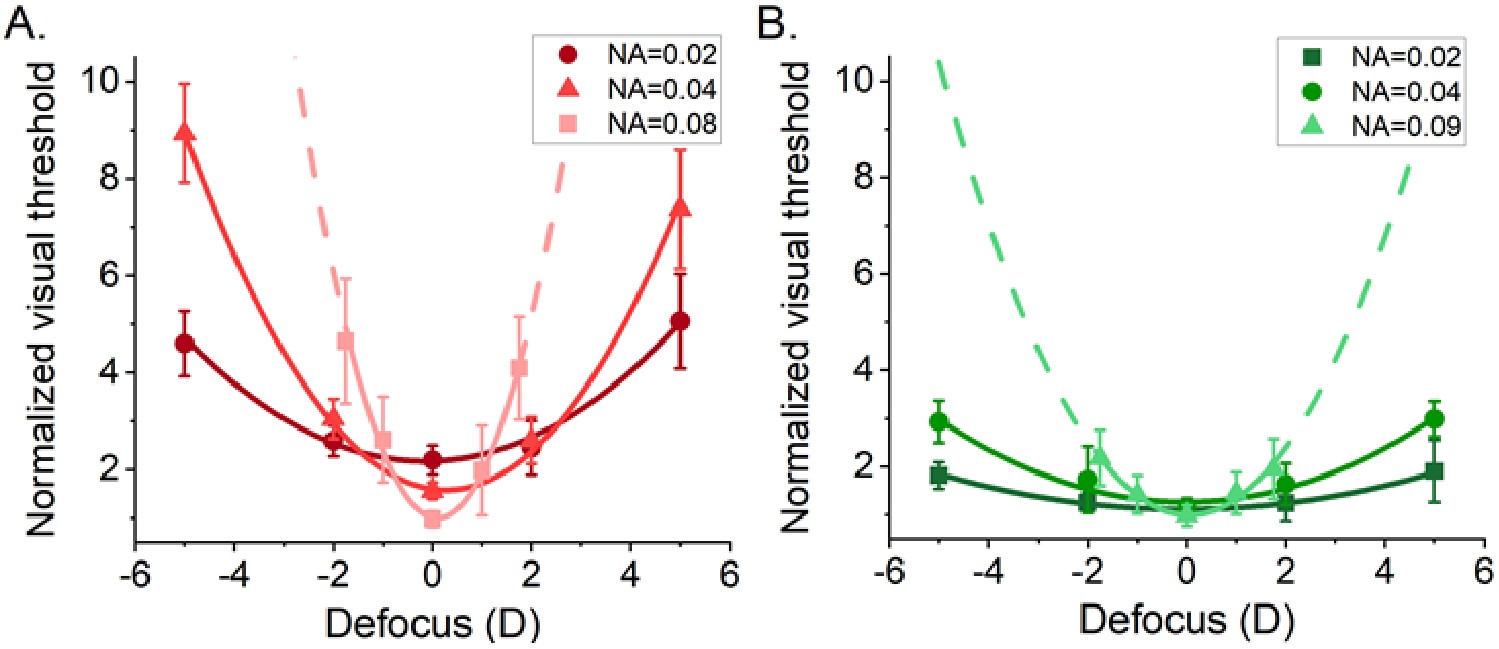
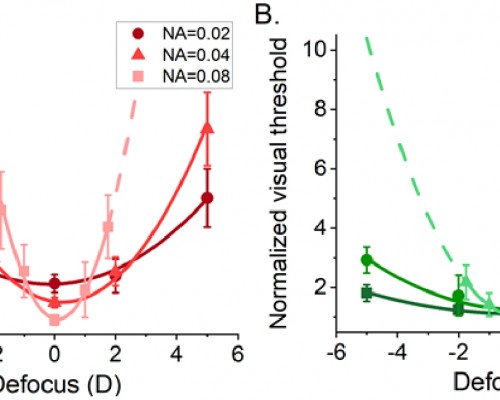
The main conclusion was clear: in two-photon vision, beam diameter matters significantly. When the light was accurately focused on the retina, the visibility threshold for the infrared stimulus changed substantially with variations in beam diameter. No such effect was observed for visible light.
This means that in two-photon vision, beam geometry is not merely a technical detail. It is one of the key factors determining whether a stimulus will be visible at all. The more tightly the light is focused, the greater the photon density reaching the retina - and consequently, the higher the probability of a two-photon absorption event.
The researchers also demonstrated that two-photon vision is more sensitive to defocus than conventional vision. And this is where one of the study’s most intriguing observations emerged. In classical vision, blur primarily reduces image sharpness. In two-photon vision, however, the infrared stimulus lost intensity much faster than it lost sharpness. In other words, instead of becoming blurry, it simply faded away.
This is an important distinction because it shows that, in this context, the retina behaves like a nonlinear light detector. Even a small loss of energy concentration at the focal point can significantly reduce stimulation efficiency. In practical terms, this means that precise optical alignment is even more critical in two-photon vision than in ordinary sight.
Why does this matter beyond the laboratory?
At first glance, this may seem like a highly specialized problem at the intersection of physics and optics. In reality, the findings could have important medical applications. A better understanding of two-photon vision may help researchers design more accurate devices for assessing retinal function, including two-photon microperimetry systems.
Such technologies could eventually support the detection and monitoring of eye diseases, including glaucoma, diabetic retinopathy, and age-related macular degeneration. The authors note that two-photon vision has already been investigated in the context of these conditions, and the new study provides knowledge that may help refine future diagnostic tools.
"Understanding these relationships is crucial if we want to transform the phenomenon of two-photon vision into practical diagnostic tools and future display technologies. The better we understand the physics of this process, the more effectively we will be able to apply it in practice," says Dr. Katarzyna Komar from the International Centre for Translational Eye Research (ICTER), Institute of Physical Chemistry, Polish Academy of Sciences.
The results also suggest that smaller beam diameters may be less sensitive to focusing errors. This could prove advantageous in real clinical environments, where achieving perfect optical alignment is often difficult. On the other hand, applications requiring maximum efficiency and precision will still demand extremely accurate focusing control.
Another step toward understanding the limits of vision
The authors emphasize that the study involved only a small group of participants, yet the results were highly consistent. The key conclusion remains clear: thresholds for two-photon vision depend more strongly on beam diameter and defocus than those for classical vision. This provides further evidence that two-photon vision follows fundamentally different rules than ordinary sight.
The study also highlights something broader. The limits of human vision are more complex than scientists once believed. Under specific conditions, the human eye can respond to stimuli that appear to lie beyond its natural capabilities. But to "see the invisible," light must reach the retina with extraordinary precision.
------------------------------------------------------------------------------------------------------------------
Agnieszka Zielińska, Daniel Rumiński, Maciej Szkulmowski, Maciej Wojtkowski, and Katarzyna Komar (2026). Effect of laser-beam diameter on the visibility of two-photon stimuli. Optics Letters.
- Author: Scientific Editor Marcin Powęska
- Contact: mpoweska@ichf.edu.pl
- Photo source: Photo: Depositphotos, Optica Publishing Group
- Date: 14.05.2026