Magnetic pulling of the strings
Reading time: about 7 minuts
Animal studies often fail to predict human tissue responses to new drugs or newly developed therapies. Besides generating tremendous costs for clinical studies, it also raises significant ethical concerns. Therefore, novel approaches in mimicking natural human environments like vascular system growth control, are broadly developed to deliver a reproducible model to test novel drugs. Recently, researchers from the Institute of Physical Chemistry demonstrated a unique system that is based on endothelial cells coated onto the surface of microparticles that can be spatially organized into pre-designed patterns to initiate the growth of vascular systems of well-defined micro-architecture. The patterning is achieved via directed-assembly using external magnetic fields. The discovery opens up new opportunities for personalized drug testing and precision medicine. Let’s take a cool closer on this breakthrough.
Every day, humankind struggles with health issues like cancer and autoimmunological diseases, boosting the development of many new drugs globally. However, despite tremendous technological progress in recent decades, the journey of a chemical compound to be applied as a new drug from its discovery to clinical use takes many years and tremendous costs. Before its use on patients, the proposed drug must undergo years of laboratory research and rigorous procedures of its testing to ensure safety and effectiveness, mainly on an animal models, before being tested on humans. Nevertheless, animal models do not always accurately reflect the biological profile of the disease. It is mainly due to the different physiological profile of different species. As a consequence, the years of research and financial resources are being lost, dramatically increasing the overall cost of treatment and slowing down the introduction of new therapeutic agents. To face this issue, global efforts are taken to replace animal experimentation - wherever it is possible - with better alternatives that could more closely resemble human physiology.
One of the most promising directions in this field is the development of advanced in vitro tissue models built from human cells in controllable laboratory conditions, facilitating the detailed studies of disease development and its inhibition mechanisms. To make the technology accessible for commercial applications, several challenges must be resolved, including the controlled reconstruction of the microvascular system that is crucial in supplying tissues with the oxygen, nutrients, and finally the tested compounds. Recent studies proposed by the team of researchers from the Institute of Physical Chemistry, Polish Academy of Sciences (IPC PAS) and University of Warsaw (UW), led by Dr. hab. J. Guzowski and Prof. P. Szymczak, under international collaboration with National Institute of Molecular Genetics, address these challenges. They propose a new bioengineering strategy aimed at controlled formation of vascular structures at the microscale. Their recent study, published in the Lab on a chip journal, combines cell biology, biomaterials, and physics of magnetically-driven assembly to generate systems that enable engineering, e.g., of vascularized cancer microenvironments and testing of cytostatic and/or anti-angiogenic drugs. The proposed original approach, which relies on endothelial cell patterning based on external magnetic fields, may provide a necessary breakthrough to allow vascular tissue engineering with unprecedented precision and efficiency, opening way towards development of reliable preclinical tests and personalized treatments.
Endothelial cells have a natural tendency to aggregate and spontaneously form complex vascular structures. However, the spontaneously formed structures remain intrinsically random. The team from IPC PAS proposed that the cells can be put at the surface of spherical magnetic microparticles and give rise to vascular sprouts developing at well-defined positions. Before the cells start to grow, the microparticles are arranged into arrays or lattices using magnetic field generated by tens of arrayed micromagnets, with each micromagnet controlling the position of a single microparticle. This unique approach allows to control the spacing between the sprouts, and so, precisely engineer, e.g., the development of interconnections that control the early stages of blood vessel network development. Importantly, these structures not only mimic organized tissue structures but also can be easily reproduced and scaled into a controlled tissue model.
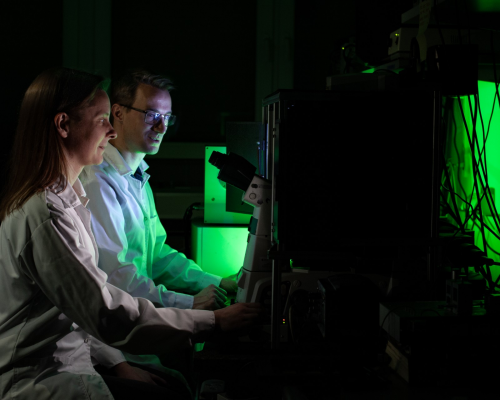
“In our work, we develop magnetic field-driven pre-patterned microvascular arrays and demonstrate their applications in engineering of cancer microenvironments and phenotypic testing of anti-angiogenic or cytostatic compounds. To test whether the engineered microvascular networks exhibit proper physiological characteristics, we investigated the 3D structural integrity of the microvessels and verified the presence of characteristic marker proteins of healthy blood vessels.” – says dr. Katarzyna Rojek – the first author of this research work.
The researchers from IPC PAS explored several different technological approaches, finally delivering the optimal methodology that is based on the use superparamagnetic microbeads as the vascular ‘seeds’ and their ordering into arrays with external magnetic field. After sprouting and interconnecting the seed-arrays eventually mature into well-organized, functional vascular networks. This approach opens possibilities for building different types of vascularized tissue models, including the models of vascularized tumors, skin, or other biological systems that have a broadly developed vascular system, allowing to replace animal-based methods with human-relevant laboratory systems.
Dr. Guzowski remarks: “We use our system to establish a critical bead-bead spacing below which the neighboring microvasculatures become interconnected, and above which they remain disconnected, even at late times of culture. In the latter case, they can be treated as practically independent biological experiments, which allows ensemble-averaging of the morphological characteristics of the sprouts. We show that the microvascular arrays co-cultured, e.g., with cancer cells, can efficiently serve as a high-throughput platform for the functional high-content screening of compounds in a full 3D microenvironment.”
Within the project, an original numerical framework for the quantitative assessment of vascular networks based on acquired microscopic images was developed by PhD student Antoni Wrzos under the guidance of Prof. Piotr Szymczak from UW. The automated image analysis allowed rapid processing of huge amounts of data and helped understand the impact of various tested drugs on living vessels.
The topic of vascular cell control is important in many fields of medicine and especially desired in oncology, where new therapies are often complex and generate high development costs. Therefore, there is a strong motivation to create improved experimental models that can more accurately predict drug efficacy and toxicity earlier in the development process. The breakthrough demonstrated by researchers from IPC PAS and UW addresses such a need, describing the smallest vascularized human tissue model that represents a significant step towards personalized medicine. Their controlled vascularized human tissue models could reduce reliance on animal testing, improve the predictive power of preclinical studies, lower the cost of drug development, and potentially enable personalized therapeutic testing in the future.
This research was supported with Polish National Science Center (NCN) by grants: Sonatina (2020/36/C/NZ1/00238), Opus (2022/45/B/ST8/03675) and Sonata (2019/35/D/ST5/03613).
CONTACT:
Dr. hab. Jan Guzowski
Institute of Physical Chemistry, Polish Academy of Sciences
email: jguzowski@ichf.edu.pl
ARTICLE:
“A comprehensive toolkit for manipulation and analysis of sprouting capillary networks based on magnetic ordering of multiple EC-coated microcarriers and their use in tissue modelling and drug testing”
Katarzyna O. Rojek, Antoni Wrzos, Fabio Maiullari, Konrad Giżyński, Maria Grazia Ceraolo, Claudia Bearzi, Roberto Rizzi, Piotr Szymczak, Jan Guzowski,
Lab Chip, 2026, 26, 875-896
DOI: https://doi.org/10.1039/D5LC00664C
The activity is implemented as part of the project “WelcomeIChF: Support and Integration of Foreign Employees at the Institute of Physical Chemistry of the Polish Academy of Sciences” (contract no. BPI/WTP/2024/1/00020/U/00001), financed by the Polish National Agency for Academic Exchange (NAWA) under the “Welcome to Poland – 2024 call” programme. The “Welcome to Poland” programme is financed by the European Union through the European Funds for Social Development 2021–2027 (FERS), under the project “Support for higher education and science institutions in serving foreigners and Poles traveling abroad”, no. FERS.01.05.IP.08-0003/24.

- Author: Dr Magdalena Osial
- Contact: magdalena@osial.eu
- Photo source: Grzegorz Krzyżewski
- Date: 19.03.2026