Systemic change and partnership: IChF leadership speaks out on the future of innovation in Poland
Reading time: about 5 minuts
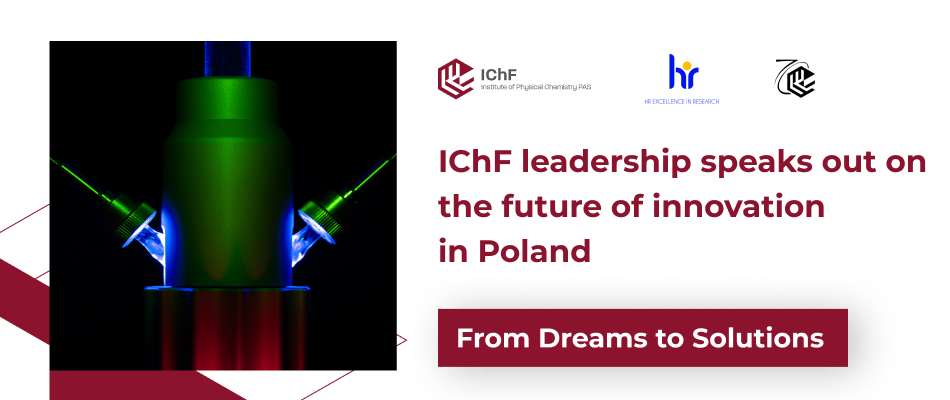
How can we create an innovation ecosystem where science, business, government, and society work together transparently, efficiently, and for the benefit of all stakeholders? How can we ensure that research results do not end up buried in grant proposals or government archives, but instead lead to real-world solutions that improve lives?
These are the key questions addressed by Adam Kubas, Director of the Institute of Physical Chemistry, Polish Academy of Sciences (IChF), and Jacek Gregorowicz, Scientific Deputy Director and Professor at IChF, in their newly published article in Forum Akademickie. Titled “Innovation in Poland: the need for systemic change and a partnership-based approach,” the article not only diagnoses the current barriers to innovation in Poland but also outlines a set of concrete proposals.
The authors point out that, despite a growing awareness of the importance of innovation, Poland still struggles with an inefficient implementation system—and the problem lies not in a lack of ideas. The public discourse is dominated by the voices of entrepreneurs, while scientific institutions and taxpayers—the very stakeholders who fund the system—are often left unheard. As the authors emphasize, “the success of each party involved must serve as the driving force behind innovation.”
One of the article’s central messages is the need to reinvest the profits generated from research commercialization into the development of public research institutions, as well as to establish clear and fair rules for collaboration with the private sector.
“In Poland, we generate knowledge based on severely limited public funds—institutional subsidies and research grants—laying the foundation for progress and realizing social ambitions. But we cannot expect spectacular outcomes when science is kept alive only by financial life support.”
In order for Poland’s innovation market to grow, the system must allow each participant to achieve meaningful returns—both material and intangible—within a reasonable time frame. Public funds should be managed to ensure the stable development of the scientific sector, which in turn generates innovation supply. The transfer of intellectual property to private companies must be governed by transparent and competitive rules, so that research institutions can benefit from the success of their spin-offs and industrial partners. As the authors write:
“The business world would be eager to take over every solution generated by the scientific community for next to nothing—only to turn it into a marketable product. Such motives, though ethically questionable, could still stimulate the innovation market if the taxes from these activities were reinvested by the government back into the scientific system.”
They also argue forcefully for increasing Poland’s overall investment in science to at least 3% of GDP and ensuring institutional stability:
“Chronically underfunded research units struggle to retain staff and maintain operational continuity. Entrepreneurs often complain that researchers are difficult to work with and don’t understand the business world. But how can bold decisions be made when you don’t know whether you’ll be able to pay your utility bills?”
The article also presents examples from IChF’s own experience in commercializing scientific research. The Institute is actively engaged in both spin-off creation—such as Scope Fluidics, InCellVu, and Living Networks—and internal pre-commercialization initiatives, including Siliquan (fluorescent nanoparticles), Cell-In (a platform for delivering compounds into cells), and Formi Technologies (rapid bacterial identification).
The authors stress that people—not just systems—are the real engines of discovery. Their perseverance is what transforms knowledge into a spin-off and eventually into a thriving company.
“On their path, innovators face many market traps. It is the role of scientific institutions to support them throughout the commercialization process, in a way that maximizes their chances of success and ensures that part of the returns can be reinvested. These resources, in turn, can help create better working conditions and further scientific progress.”
As a source of inspiration, the authors refer to the model used at Delft University of Technology in the Netherlands, where research activities, technology transfer offices, support infrastructure, and spin-off incubators are co-located. The Dutch system is based on collaboration between universities, the government, and private companies. A particularly interesting component is the auction-based share offering mechanism for start-ups—allowing universities, companies, and individuals to invest on equal footing. This enables market-driven valuation and avoids accusations of illegal state aid.
In their conclusion, the authors write:
“We cannot speak of partnership if we fail to recognize the value of knowledge created using taxpayers' money—scientists’ salaries, research equipment, and so on. On the other hand, we also cannot ignore the need to build institutional know-how in knowledge transfer and to actively encourage researchers to undertake the demanding process of commercializing their work. As we have demonstrated in this article, Poland’s weak innovation market is a complex issue. However, by implementing systemic solutions based on transparency, effective use of public funds, and reinvestment in science, we can join the global innovation leaders.”
As the Institute of Physical Chemistry, Polish Academy of Sciences celebrates its 70th anniversary this year, its leadership reaffirms the belief that only through systemic change, transparency, shared responsibility, and genuine partnership can Poland build a strong, future-oriented innovation ecosystem.
We invite you to read the article (in Polish) on the Forum Akademickie website: https://forumakademickie.pl/innowacje-w-polsce-potrzeba-systemowej-zmiany-i-partnerskiego-podejscia.
- Author: Dr. Anna Przybyło-Józefowicz
- Photo source: Photo: Grzegorz Krzyżewski
- Date: 23.07.2025