Dream Chemistry Lecture with Dr. Kasra Amini (Max-Born-Institut, Berlin)
Reading time: about 3 minuts
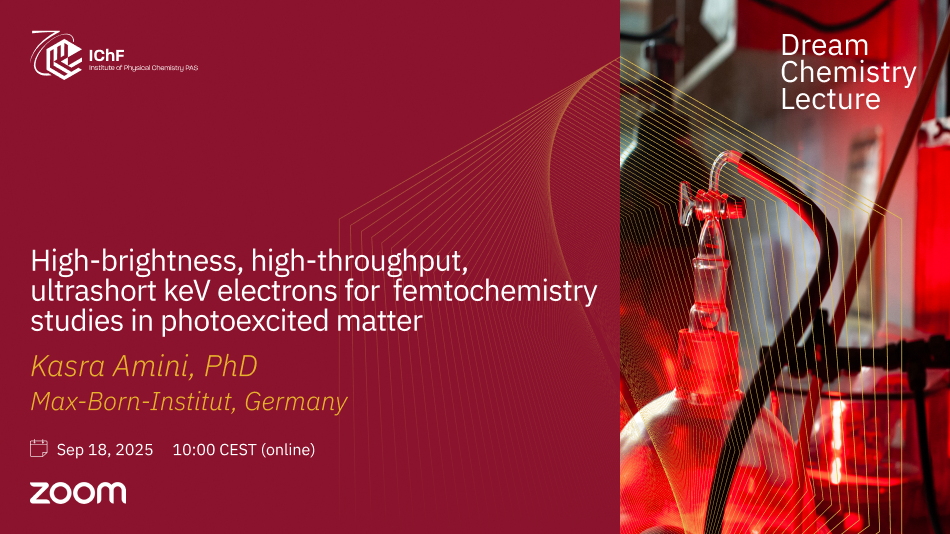
We warmly invite you to join the next lecture in our Dream Chemistry series at the Institute of Physical Chemistry, Polish Academy of Sciences. Our guest speaker will be Dr. Kasra Amini, group leader at the Max-Born-Institut in Berlin and Principal Investigator of the ERC Starting Grant project TERES. With a PhD from the University of Oxford (awarded with a rare commendation), Dr. Amini has previously worked at ICFO in Spain and now leads a cutting-edge laboratory developing advanced ultrafast electron diffraction (UED) techniques. His group develops advanced RF-compressed ultrafast electron diffraction (UED) techniques, including THz electron streaking in gas-phase and solid-state thin films. His research has been featured in PNAS, Nature Communications, and Optica, and he is co-editor of the Royal Society of Chemistry volume "Structural Dynamics with X-ray and Electron Scattering". He was named an Emerging Leader by J. Phys. B in 2020.
Title: "High-brightness, high-throughput, ultrashort keV electrons for femtochemistry studies in photoexcited matter"
Date: Thursday, September 18, 2025
Time: 10:00 AM (CEST)
Format: Online via Zoom
Link: https://zoom.us/j/94079507565?pwd=aqwJZYGCRch3aAYI0x5kQXAyvKRypz.1&
Meeting ID: 940 7950 7565
Access code: 577560
Abstract:
Since the pioneering work of Mourou [1] and Zewail [2], ultrafast electron diffraction (UED) has become the method of choice to study femtosecond structural dynamics in photoexcited matter, reaching picometre spatial and 100–240 fs temporal resolution in gas-phase and condensed systems [3–6]. Compact 100 keV UED instruments offer attractive simplicity and accessibility compared to facility-based MeV sources, but their performance is fundamentally constrained by space-charge effects [6]. For example, weakly relativistic 100 keV electron beams (0.55c) of high bunch charges (~20 fC) are often employed to achieve sufficient scattering signals at 1 kHz repetition rates, leading to space-charge broadening of electron pulses beyond the sub-picosecond regime. Even with radiofrequency (RF) [7] or THz compression [8], high-charge operation at 1 kHz limits pulse durations to ~150 fs, while single-electron operation at high repetition rate sacrifices throughput. Highly relativistic 3 MeV beams (0.99c) reduce space-charge effects by ~1,000 to achieve 29 fs compressed pulses [3], but their RF-driven accelerator source restricts it to 1 kHz operation, long beamlines (5-8 metres), indirect detection, and limited beamtime access.
We present a high-brightness, high-throughput 90 keV UED platform that overcomes these limitations. Using an RF compression cavity synchronized to the drive laser with <6 fs FWHM precision [9], we compress 0.4 - 7.4 ps electron pulses down to 91 - 114 fs, corresponding to a >65 compression factor, with charges ranging from 100 to 35,000 electrons per pulse, as confirmed with THz electron streaking [8]. Operating at 40 - 100 kHz with direct electron detection, our instrument combines femtosecond pulse durations with unprecedented throughput in the keV regime. Compared to state-of-the-art keV systems (>16 aC), our beam achieves shorter compressed durations (91 fs .vs. 100 - 150 fs) with higher brightness, while exceeding both keV and MeV UED in usable throughput by orders of magnitude.
In our recent work [10], we also detected time-resolved scattering signals with single-electron pulses and resolved electron-phonon dynamics in aluminium at 30 kHz using uncompressed beams. Here, we extend these capabilities into the high-charge regime via RF compression, combining high brightness (a per-pulse metric) with high throughput (a per-second metric). With high repetition rates, robust normalization to the measured unscattered beam, and direct detection, our instrument delivers among the brightest relativistic electron pulses and orders-of-magnitude higher usable throughput in the world, enabling high-sensitivity UED of gases, nanostructures, and photoinduced phase transitions.
References
[1] G. Mourou and S. Williamson, Appl. Phys. Lett. 41, 44–45 (1982).
[2] J. C. Williamson et al., Nature 386, 159–162 (1997).
[3] F. Qi et al., Phys. Rev. Lett. 124, 134803 (2020).
[4] X. Shen et al., Struct. Dyn. 6, 054305 (2019).
[5] T. Xiong et al., Phys. Rev. Res. 2, 043064 (2020).
[6] D. Filippetto et al., Rev. Mod. Phys. 94, 045004 (2022).
[7] T. van Oudheusden et al., Phys. Rev. Lett. 105, 264801 (2010).
[8] C. Kealhofer et al., Science 352, 429 (2016).
[9] M. R. Otto et al., Struct. Dyn. 4, 051101 (2017).
[10] F. R. Diaz et al., Struct. Dyn. 11, 054302 (2024).
The event is open to all interested audiences.
- Date: 16.09.2025