Invitation to the Dream Chemistry Lecture on 4 September, 2025
Reading time: about 2 minuts
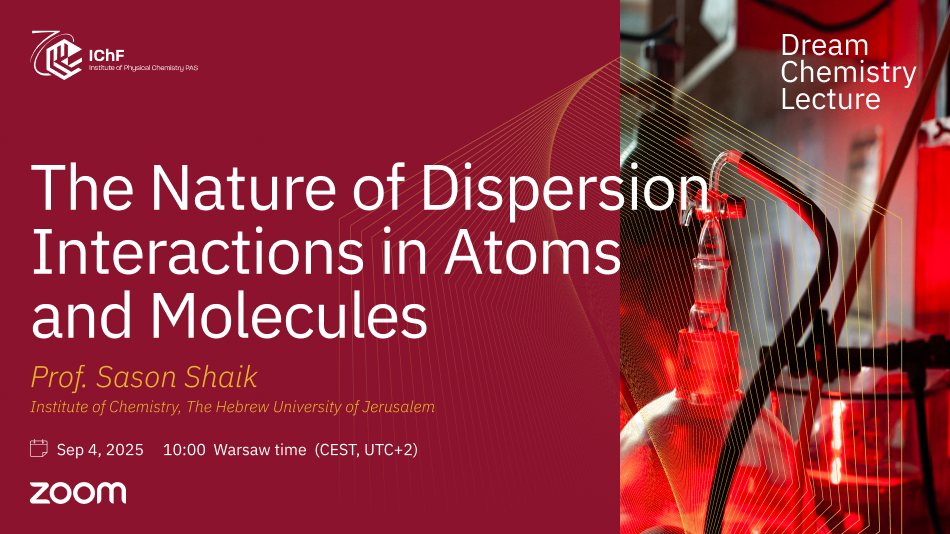
The Institute of Physical Chemistry, Polish Academy of Sciences, cordially invites you to the next Dream Chemistry Lecture, to be delivered by Prof. Sason Shaik from The Hebrew University of Jerusalem.
Prof. Sason Shaik is the Emeritus Professor of Chemistry at the Institute of Chemistry, The Hebrew University of Jerusalem (Givat Ram Campus). He is a Fellow of the American Association for the Advancement of Science (AAAS), the International Academy of Quantum Molecular Science (IAQMS), and serves as a Board Fellow of the World Association of Theoretical and Computational Chemists (WATOC). He has been elected as a Foreign Member of the French Academy of Sciences and as a Member of the Israeli Academy of Sciences. In recognition of his achievements, he has received the Schrödinger Medal of WATOC, the August-Wilhelm-von Hoffman Gold Medal of the German Chemical Society, and the Gold Medal of the Israel Chemical Society.
Date: 4 September 2025 (Thursday), 10:00 am Warsaw time (CEST, UTC+2)
Format: online (Zoom) – https://zoom.us/j/91619840781?pwd=amnqz4VFLQK2xTL99KgprzbIT5DMUi.1&from=addon
ID: 916 1984 0781
Access code: 627195
Lecture title:
"The Nature of Dispersion Interactions in Atoms and Molecules"
The abstract of the lecture is available below.
We present computational results of many-body dispersion (MBD) interactions for 40 variegated pairs of molecular and atomic species: hydrocarbons, hydrosilanes, corresponding fluorinated derivatives, pairs which have multiple H---H interactions between the molecules, as well as pairs having p-p interactions, and pairs of noble gases. The calculations, reveal that the MBD stabilization energy (EDISP,MBD) obeys a global relationship, which is gravitational-like. It is proportional to the product of the masses of the two molecules (M1xM2) and inversely proportional to the corresponding distances between the molecular centers of mass (RCOM-COM) or the H---H distances (RH-H) of the atoms mediating the interactions of the two molecules. This relationship reflects the interactions of instantaneous dipoles, which are formed by the ensemble of bonds/atoms in the interacting molecules. Using the D4-corrected dispersion energy (EDISP,D4), which accounts for three-body interactions, we find that the EDISP,MBD and EDISP,D4 data-sets are strongly correlated (Figure 3). Based on past valence-bond modelling (Ref. 14), the dispersion interactions transpire primarily due to the increased contributions of the oscillating-ionic VB structures which maintain favorable electrostatic interactions, namely [Sub—C+ :H– +H :C– —Sub] and [Sub—C:– +H :H– C+—Sub]. This augmented contribution is attended by simultaneously diminished-weights of the destabilizing pair of structures, [Sub—C+ :H– –:H C+—Sub] and [Sub— :C– H+ +H :C– —Sub]; Sub symbolizes general residues. The local charges are propagated to tßhe entire ensemble of bonds/atoms by partially charging the Sub residues, thus bringing about the “gravitational-like” dependence of dispersion.
We look forward to your participation!
- Date: 28.08.2025