Invitation to an Excellent Chemistry Lecture organized by Cluster 2
Reading time: about 2 minuts
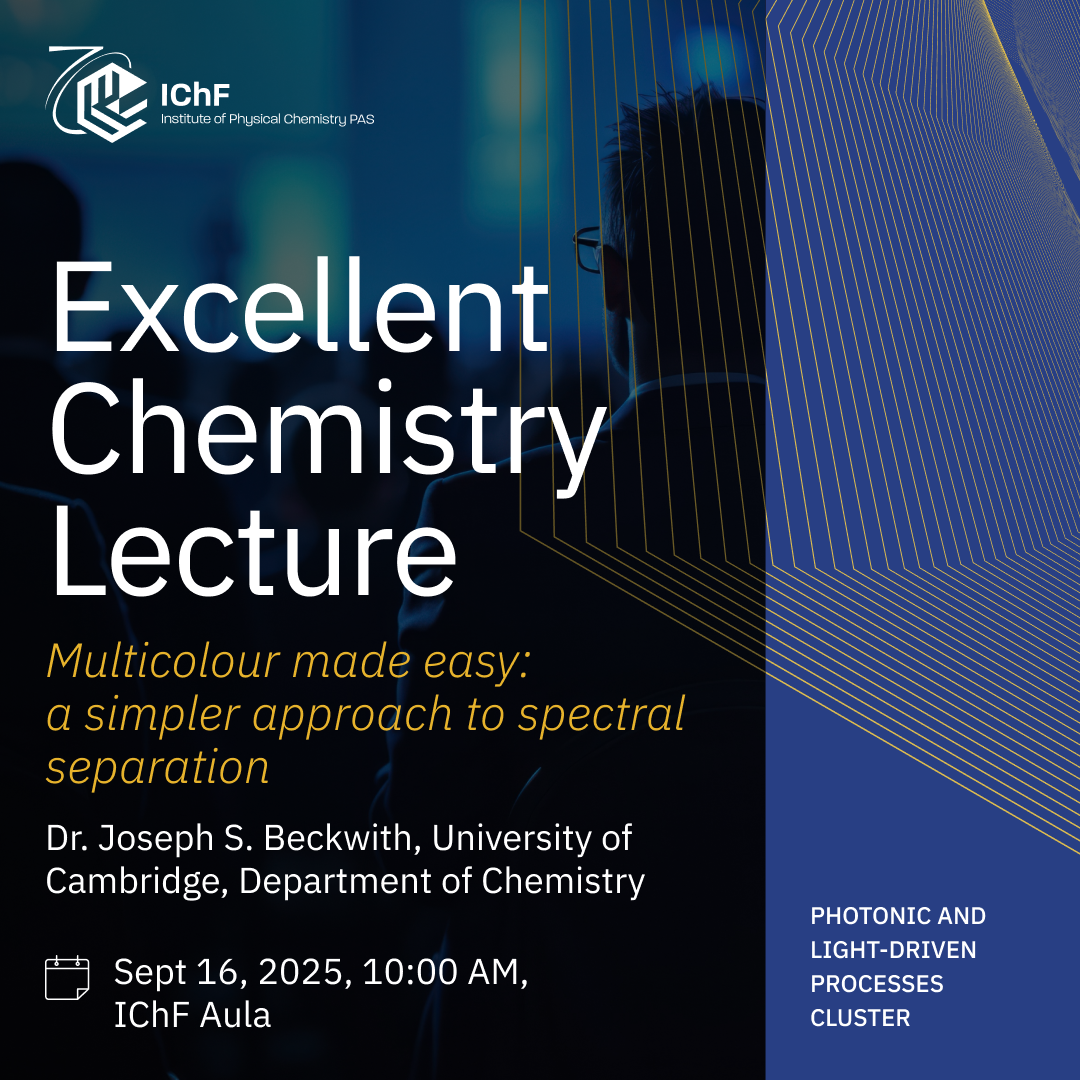
The Institute of Physical Chemistry, Polish Academy of Sciences, cordially invites you to the next Excellence Chemistry Lecture, to be delivered by Joseph S. Beckwith, PhD from the University of Cambridge, Department of Chemistry.
Joseph S. Beckwith is a Senior Research Associate in the Department of Chemistry at the University of Cambridge, working with Prof. Steven F. Lee, and previously a postdoctoral researcher at both Cambridge and Princeton (with Prof. Haw Yang). He holds a PhD in Physical Chemistry from the University of Geneva (Prof. Eric Vauthey). His work on ultrafast spectroscopy, photoinduced charge transfer, and advanced microscopy has produced 20 publications (7 first-author; 2 co-corresponding), including papers in Nature Communications, Nano Letters, and Chemistry of Materials, with a highly cited 2022 contribution in PCCP. His research has been supported by an SNSF Early Postdoctoral Fellowship and a Cambridge Enterprise Technology Investment Fund award.
Date and location: Tuesday, September 16th, 10:00 AM (CEST), IChF Aula (in-person seminar)
Lecture title: "Multicolour made easy: a simpler approach to spectral separation"
The abstract of the lecture is available below.
Multicolour and spectrally-resolved single-molecule microscopy can give considerable biological insight: fluorophores can undergo spectral changes in response to their local environment, providing information on the nanoscale hydrophobicity of oligomeric protein species;[1] coupling between fluorophores by FRET causes a colour change that gives insights into molecular dynamics;[2] and detecting multiple colours of fluorophore can enable super-resolution microscopy experiments to simultaneously image multiple biological targets, allowing interactions between biological structures to be uncovered on the nanoscale.[3] Current state-of-the-art instrumentation for multicolour experiments is often technically complex to implement, with the number of colours able to be deconvolved limited to about ~8. [4]
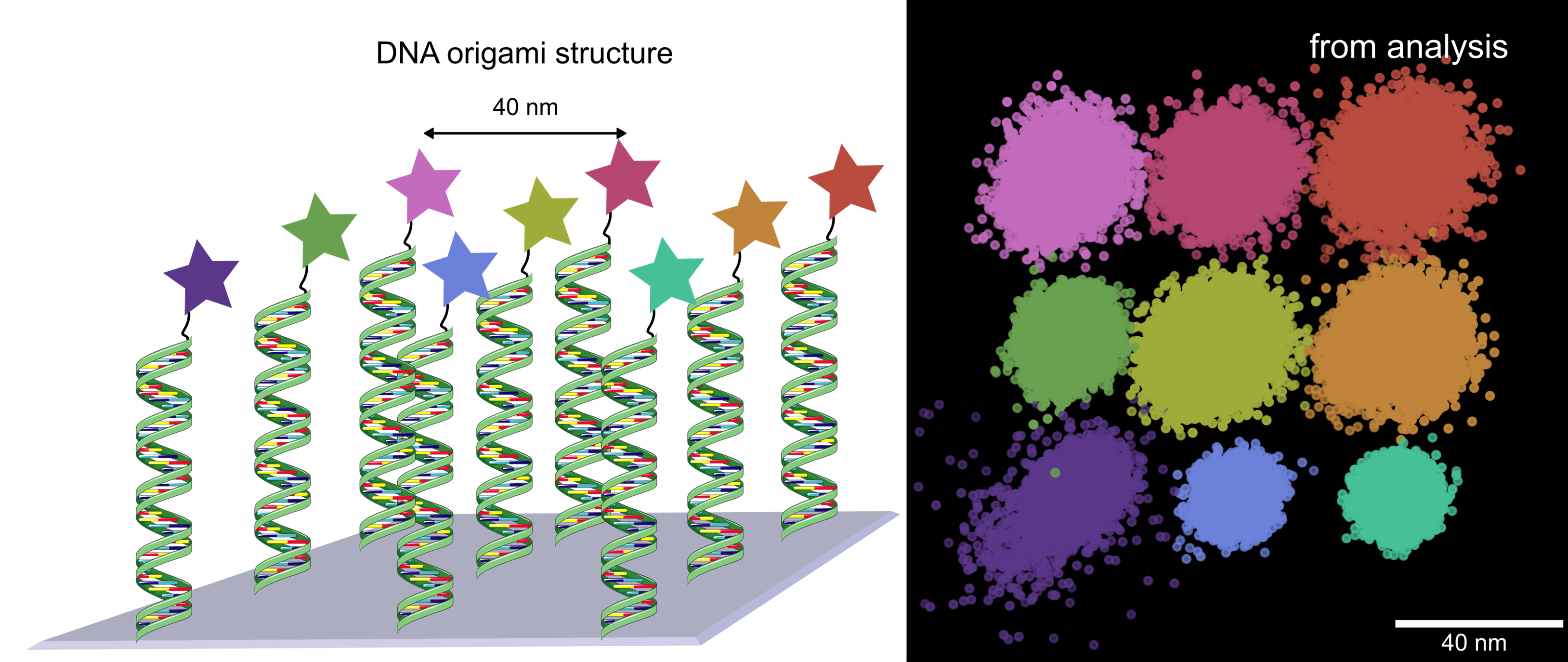
We have developed a new image analysis pipeline that works with off-the-shelf hardware. This image analysis algorithm, and the underlying information-theoretic approach, can be used to discriminate up to ~8 different fluorophores, achieving the state-of-the-art with a considerable reduction in experimental complexity. We will present experimental evidence that our method enables easy single-molecule FRET, and far greater multiplexing of multicolour super-resolution microscopy.
References
- Bongiovanni, M. N. et al. Multi-dimensional super-resolution imaging enables surface hydrophobicity mapping. Nat Commun 7, 13544 (2016).
- Hohng, S., Joo, C. & Ha, T. Single-Molecule Three-Color FRET. Biophys J 87, 1328–1337 (2004).
- Dempsey, G. T., Vaughan, J. C., Chen, K. H., Bates, M. & Zhuang, X. Evaluation of fluorophores for optimal performance in localization-based super-resolution imaging. Nat Methods 8, 1027–1036 (2011).
- Kumar, A. et. al. Multispectral live-cell imaging with uncompromised spatiotemporal resolution, biorxiv (2024) doi: 10.1101/2024.06.12.597784
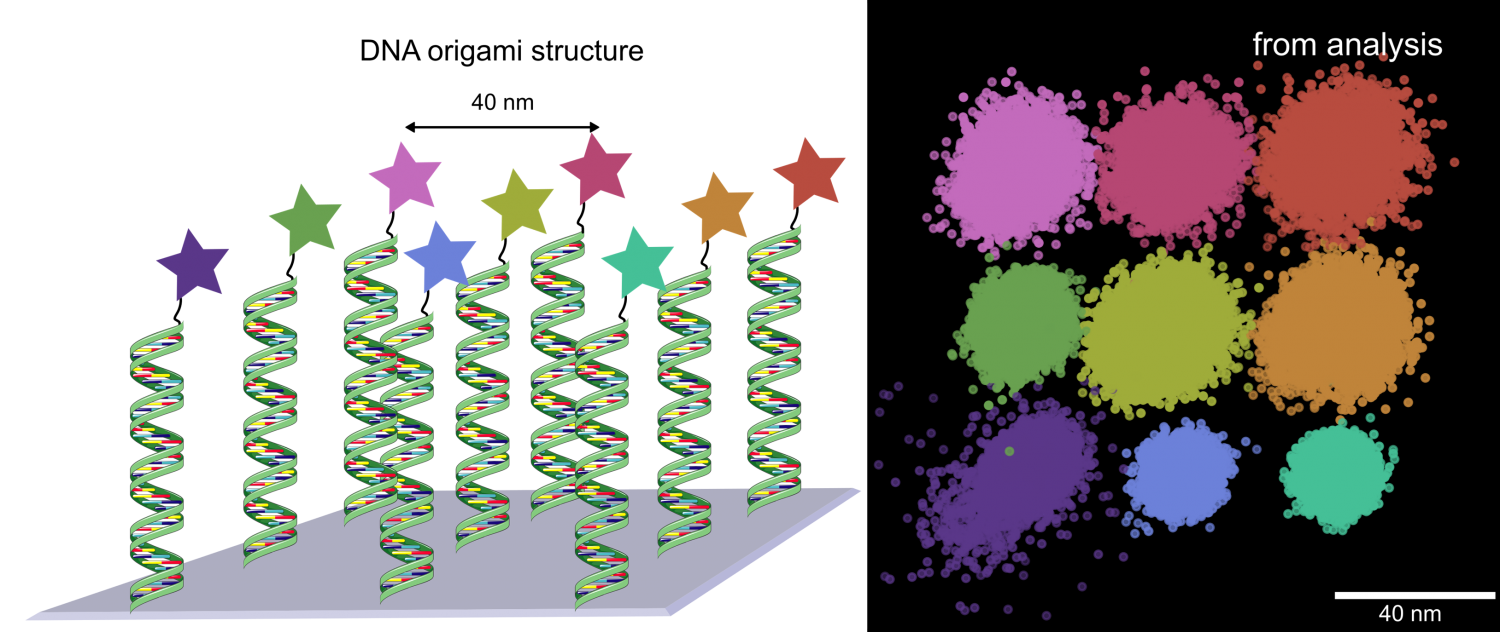
Figure 1: We are able to distinguish 9 different colours at sub-diffraction limited distances.
The event is obligatory to all Cluster 2 students, and of interest, we hope, to the whole IChF community. We look forward to your participation!
- Date: 9.09.2025