Green pharmaceuticals begin with the chemical reaction. Light and ultrasound turn biomass into valuable molecules.
Reading time: about 4 minuts
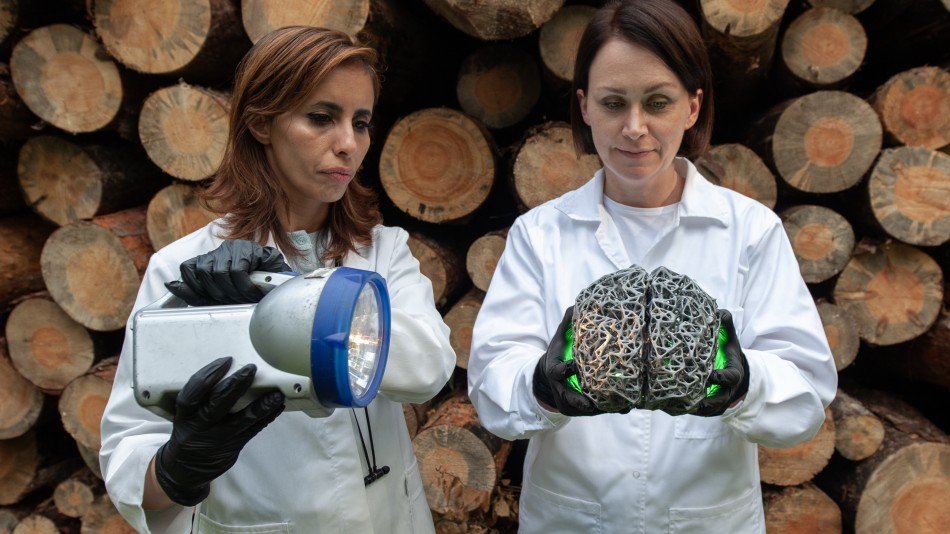
Two IPC PAS studies show how lignin-derived molecules can be transformed into compounds relevant to pharmaceutical research - at room temperature and atmospheric pressure and, in one case, without a transition-metal catalyst.
Sustainable packaging is only the beginning. What a medicine is made from - and how its ingredients are produced - matters just as much. Yet the synthesis of compounds for pharmaceutical research can still depend on fossil feedstocks, high temperatures, strong oxidants and metals that raise costs and complicate purification. Two recently published studies from Prof. Colmenares' group at IPC PAS demonstrate that cleaner chemistry can begin at the level of a single chemical bond [1][2].
At the heart of both studies is lignin, one of nature’s most abundant polymers and a major by-product of wood processing. Instead of simply burning it, chemists can use its aromatic structures as building blocks for much more valuable compounds. The teams combined this renewable feedstock with light and ultrasound. Light activates the catalyst, while inaudible sound waves produce cavitation: microscopic bubbles form and collapse violently. Energy is generated locally, where the chemistry happens, without exposing the whole system to extreme heat.
“Tuning” ultrasound to make a valuable compound
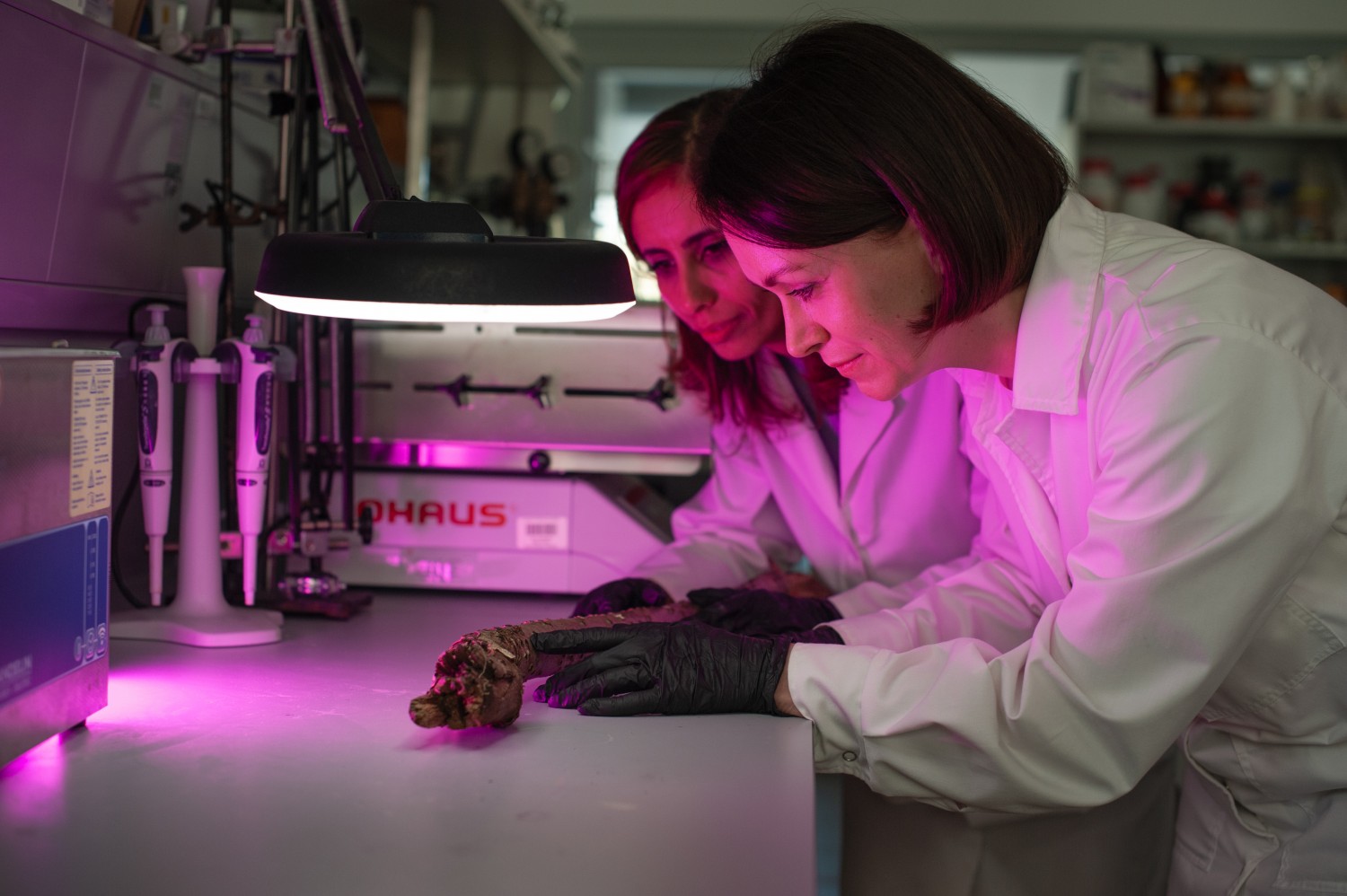
Dr. Marta Paszkiewicz-Gawron and colleagues transformed coniferyl alcohol into dehydrodiconiferyl alcohol (DHCA), a compound formed by linking two coniferyl alcohol units. Under optimized conditions, the reaction achieved 100% substrate conversion and 54% selectivity to DHCA, while remaining stable during a 24-hour test. Acoustic-field mapping showed that ultrasound is not merely a mixing tool: its intensity and distribution can steer the product profile. DHCA has previously been investigated in preclinical studies of wound healing and the regulation of bone-forming cells [1].
From wood and crustacean shells to diapocynin
Ms. Behdokht Hashemi Hosseini and colleagues created a metal-free catalyst from lignin and chitosan, which is obtained from chitin found in sources such as crustacean shells. It joined two acetovanillone molecules to form diapocynin with more than 97% selectivity and a 33% yield. Diapocynin - the dimer of the NADPH oxidase inhibitor apocynin - is being investigated in disease models for limiting damaging reactive oxygen species. The result proves that advanced C–C coupling can be achieved without a transition-metal catalyst [2].
Lignin need not end up as fuel, nor crustacean shells as waste. Together, they can become part of cleaner chemistry for pharmaceutical research.
Both studies came from IPC PAS Research Group 28, “Catalysis for Sustainable Energy Production and Environmental Protection,” led by Prof. Juan Carlos Colmenares. They are laboratory proofs of concept, not finished medicines or industrial processes. Yield, molecular scope and scale-up still require further work. But the direction is clear: better use of local biological resources, less reliance on scarce metals and fossil feedstocks, and more precise processes for pharmaceutical research and specialty chemistry.
PUBLISHED STUDIES
[1] Sonophotocatalytic dimerization of coniferyl alcohol – The influence of energy distribution during sonication. Ultrasonics Sonochemistry 133 (2026), 108020.
DOI: 10.1016/j.ultsonch.2026.108020
[2] Metal-Free Sonophotocatalytic C–C Coupling of Acetovanillone Using a Synthesis-Frequency-Tuned Chitosan–Lignin Hybrid Catalyst. Chemistry – A European Journal (2026), e71533.
DOI: https://doi.org/10.1002/chem.71533
Funding: National Science Centre, Poland: OPUS 26 (2023/51/B/ST5/00752) and OPUS 20 (2020/39/B/ST5/00076).
Scientific contacts: Dr. Marta Paszkiewicz-Gawron — mpaszkiewicz-gawron@ichf.edu.pl | Behdokht Hashemi Hosseini — bhashemi.hosseini@ichf.edu.pl | Prof. Juan Carlos Colmenares — jcarloscolmenares@ichf.edu.pl

Project “WelcomeIChF: Support and Integration of Foreign Employees at IChF PAS” (contract no. BPI/WTP/2024/1/00020/U/00001) is funded by the Polish National Agency for Academic Exchange (NAWA) under the “Welcome to Poland – 2024 call” programme.
The Welcome to Poland programme is co-financed by the European Union through the European Fund for Social Development 2021–2027 (FERS), within the project “Support for higher education and science institutions in serving foreigners and Poles traveling abroad” (no. FERS.01.05.IP.08-0003/24).
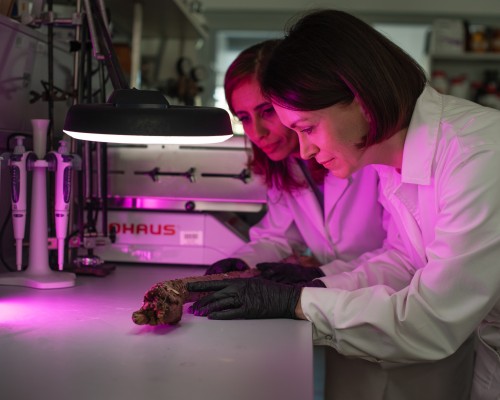
- Author: Dr. Marta Paszkiewicz-Gawron, Behdokht Hashemi Hosseini
- Photo source: Grzegorz Krzyżewski
- Date: 12.10.2026