An image that resists blur: ICTER measures defocus tolerance in two-photon vision
Reading time: about 7 minuts
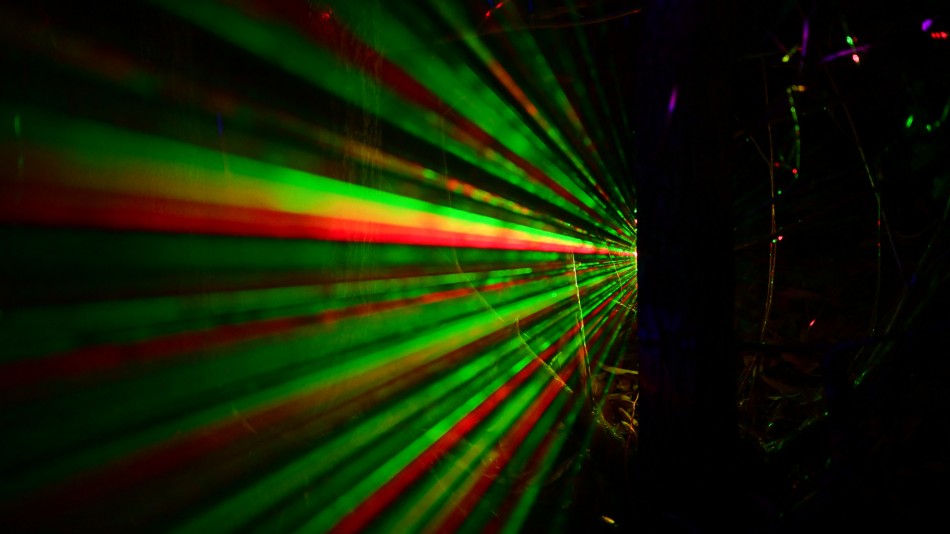
Infrared light is invisible to us. Yet under the right conditions, pulses of near-infrared light can give rise to a visible image in the eye - one that behaves in ways that defy intuition. ICTER scientists investigated what happens to that image when it is no longer perfectly focused.
A healthy eye automatically adjusts its focus to match the distance of the object we are looking at. When we shift our gaze from the far end of the street to a phone, the lens changes shape to keep the retinal image sharp. This process is called accommodation. It usually happens without us noticing, but head-mounted displays such as VR and AR headsets can place the eye in an unusual situation. A virtual object may appear at one distance while the display’s optics require the eye to focus on a different plane.
Scientists at the International Centre for Translational Eye Research (ICTER), based at the Institute of Physical Chemistry, Polish Academy of Sciences, are investigating ways to display images using two-photon vision. In this phenomenon, pulses of near-infrared light - normally invisible to humans - can stimulate visual pigments in the retina when two photons are absorbed almost simultaneously. Their combined energy corresponds roughly to that of a single photon at half the wavelength. As a result, infrared light at about 1040 nm can produce a colour sensation similar to 520-nm green light.
The study was conducted by an international team made up predominantly of ICTER scientists: Oliwia Kaczkoś, Mateusz Grochalski, Katarzyna Komar, and Maciej Wojtkowski, director of ICTER. María Viñas Peña of the Institute of Optics at the Spanish National Research Council (CSIC) in Madrid and Jacek Pniewski of the Faculty of Physics at the University of Warsaw also contributed to the research. The results were published in Optics Letters in the article entitled, “Extended defocus tolerance for image quality in two-photon vision.”
“We already knew that near-infrared light could produce a visible image. This time, we wanted to ask a more practical question: how much defocus can such an image tolerate before it begins to look blurred?” says Oliwia Kaczkoś, the paper’s first author.
Two green letters, two ways of seeing
The experiment involved 12 healthy participants: eight men and four women aged 25-47. All had best-corrected visual acuity of 20/20 or better, only minor refractive errors, and no diagnosed eye disease.
Measurements were taken using each participant’s dominant eye, while the other was covered. No drugs were used to block accommodation, allowing the eye to respond naturally to defocus. Before the experiment, the researchers measured each participant’s amplitude of accommodation - the range over which the eye’s lens can still change its optical power. Participants with an amplitude above 5 diopters formed the non-presbyopic group; those with an amplitude of 5 diopters or less formed the presbyopic group.
The stimulus was a small letter E subtending 12.5 arcminutes. Rather than being shown on a conventional screen, it was drawn by a scanning laser. A laser spot moved across the retina quickly enough to form the complete letter, refreshing the pattern 50 times per second so that it appeared continuous.
The letter was generated in two ways. The first used visible light at 520 nm. The second used ultrashort near-infrared pulses at about 1040 nm, perceived through two-photon absorption. In both cases, participants saw a green letter E, and the stimuli were individually matched for perceived brightness.
The researchers then introduced increasing amounts of negative defocus in 0.5-dioptre steps. Participants reported the first point at which they perceived slight but sustained blur. The corresponding value was recorded as the defocus tolerance. Each condition was measured three times.
“We wanted to compare the two conditions as fairly as possible. Participants saw a green letter E in both cases, and we matched the perceived brightness separately for each person. Only then did we increase the defocus in 0.5-diopter steps until a slight but persistent blur appeared,” explains Mateusz Grochalski of ICTER.
A focus range more than 40% wider
The main finding was consistent across all 12 participants: the two-photon image tolerated greater defocus before participants perceived it as persistently blurred.
“The key point was that we observed the effect in all 12 participants. Its size varied, but the pattern was consistent: the two-photon image continued to appear sharp at substantially greater defocus than the conventional visible-light image,” says Oliwia Kaczkoś.
Another important finding was that the two-photon advantage persisted in participants with presbyopia, the age-related physiological decline in the eye’s ability to focus on nearby objects.
The largest difference was observed with the non-presbyopic group. Participants in this group first reported persistent blur at a mean-imposed defocus of 6.6 ± 0.7 diopters for the two-photon stimulus, compared with 4.3 ± 0.7 diopters for the visible-light stimulus. Thresholds were lower in the presbyopic group, which had a smaller amplitude of accommodation, but the two-photon advantage remained: 2.7 ± 0.4 versus 1.9 ± 0.3 diopters.
In both groups, the range over which the two-photon image continued to appear sharp was more than 1.4 times as wide as for the conventional visible-light image. Across all participants, the additional margin averaged 1.7 ± 0.3 diopters. The differences were statistically significant.
Why does the image stay sharp despite defocus?
This property stems from the quadratic dependence of two-photon absorption on local light intensity. If the local intensity is halved, the two-photon excitation signal falls to one quarter. The faint, diffuse parts of a defocused beam therefore contribute much less to the retinal response, allowing the edges to remain well defined at greater defocus.
Earlier studies showed that a two-photon image can dim as defocus increases. The present study did not measure brightness; it quantified how much defocus the image could tolerate before participants perceived it as persistently blurred.
Computer simulations of the eye supported the explanation related to the quadratic dependence. As defocus increased, the letter produced by conventional visible light lost its sharp edges more quickly, while its two-photon counterpart remained recognizable across a wider range.
“The important step was to put a number on what had previously been a qualitative observation. We now know not only that a two-photon image responds differently to defocus, but also how large that difference is. This gives us a benchmark for further work on two-photon retinal displays,” says Katarzyna Komar, a senior researcher at ICTER.
What could this mean in practice?
The ability of a two-photon image to appear sharp despite greater defocus could have practical implications for AR glasses. In such devices, vergence cues may place a virtual object at one depth while accommodation remains tied to the display’s focal plane. This mismatch or depth ambiguity, known as the vergence-accommodation conflict (VAC), is one cause of visual discomfort in augmented reality.
An image that is less sensitive to defocus could make its quality less dependent on an exact accommodative response. In practice, this might make it easier to shift one’s gaze between digital information and the physical environment, for example when repairing equipment or during a medical procedure. This is a potential application of two-photon vision that will require further study.
Could it Improve visual comfort? That remains to be tested
The current study measured the threshold for perceived blur under standardised laboratory conditions, with monocular stimulation and controlled defocus. It did not test visual comfort or fatigue during prolonged use. The findings nevertheless provide a starting point for examining the eye’s dynamic accommodative response and visual fatigue in a working AR system.
“We have shown that a two-photon image remains sharp across a wider range of defocus, including in people with a reduced amplitude of accommodation. The next challenge is to determine whether this advantage persists during prolonged use and translates into greater visual comfort. Our next step is to measure visual comfort in a working AR system,” concludes Oliwia Kaczkoś.
For now, the green letter produced by invisible infrared light has only appeared in a precisely controlled laboratory setup. Even so, the study shows that in two-photon vision, an image can remain sharp across a wider range of defocus than our experience with ordinary visible light would suggest.
- Author: Scientific Editor Marcin Powęska
- Photo source: Depositphotos
- Date: 22.10.2026