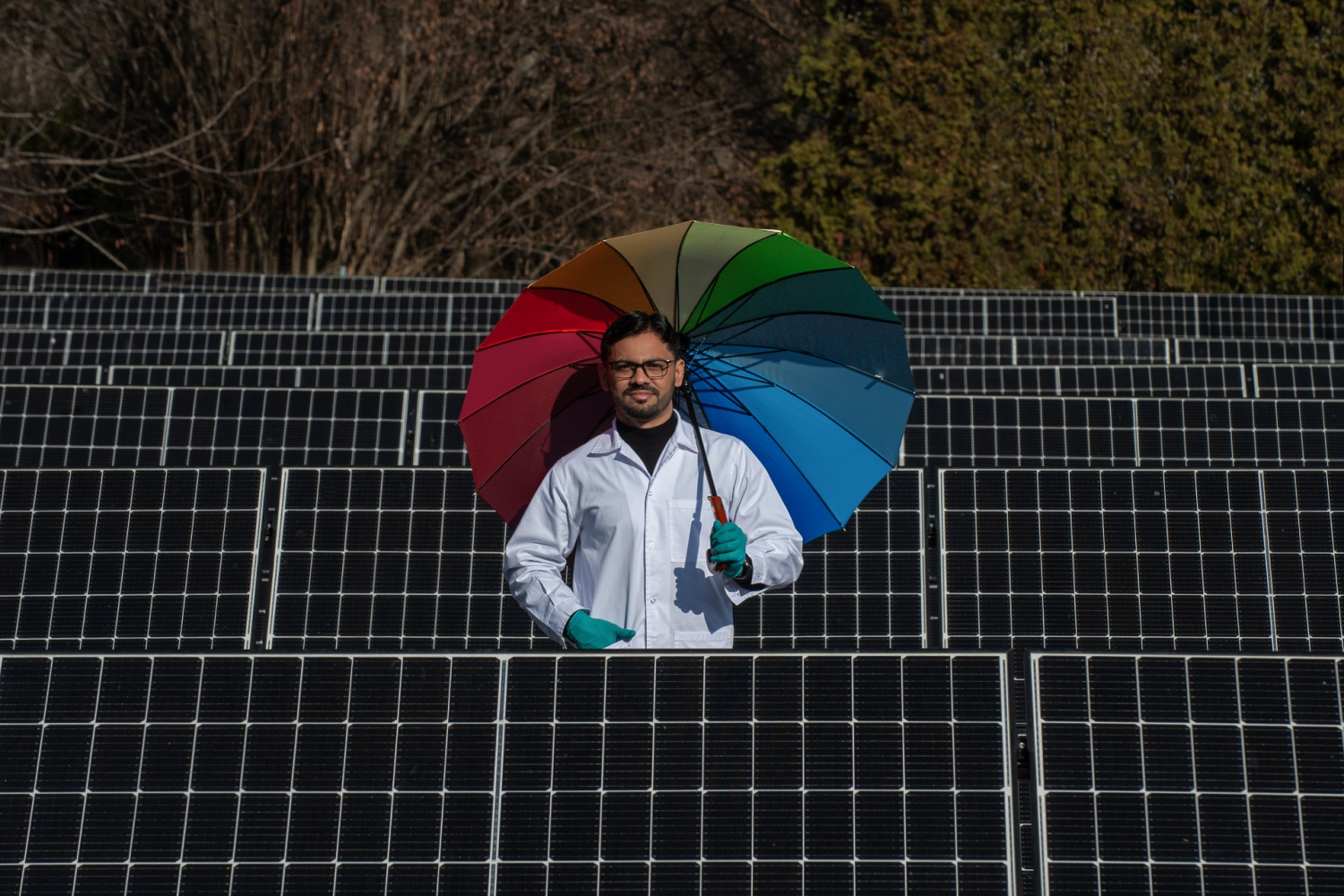
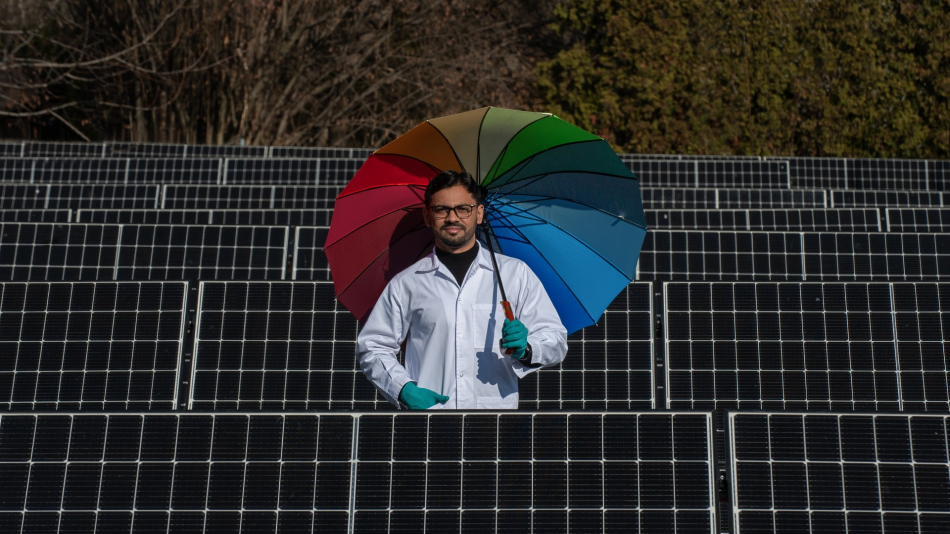
Molecular umbrella protecting the solar cell
Reading time: about 6 minuts
We live in times of the continuous growth of global energy consumption leading to the intensive studies in the development of alternative energy sources like solar cells. One of the most intensively studied material for photovoltaics just after the silicon are halide perovskites for their exceptional optoelectronic properties and potential for low-cost fabrication. However, despite remarkable energy conversion effectiveness, these materials still face application limitations that are caused by structural defects within the crystal lattice. These defects act as charge trapping centers that drastically drop the overall efficiency of the perovskite under the solar energy conversion. Recently, scientists from the Institute of Physical Chemistry, Polish Academy of Sciences (IPC PAS) led by prof. Prochowicz proposed novel 2-in-1 strategy that inhibit defects development suppressing the ions migration in the material and work as molecular umbrella that enhances hydrophobicity of photoactive material improving environmental stability. Their work is essential for achieving more efficient and durable perovskite solar cells.
Perovskites are semiconducting materials that have rapidly transformed the field of optoelectronics, demonstrating outstanding performance in light-emitting diodes (LEDs) and photodiodes. Hence, for their unique properties, they also gained attention in photovoltaics. After almost two decades of intensive research, this “wonder” class of materials makes the effectiveness of solar energy conversion in electricity comparable with conventional silicon-based technologies, which could provide a cost-effective route to significantly enhance energy generation in both large-scale solar farms and rooftop panels. However, maintaining high efficiency upon scaling up device fabrication still remains difficult for the processes that occur on the molecular level, limiting long-term stability of perovskite materials. This issue is related to the “sandwich” architecture of molecular layers in perovskite solar cells that separate and transport the charges. Once a layer converting photons into electricity degrades, the overall efficiency of the devices drops. Therefore, molecular engineering and defect passivation have become key strategies for improving both efficiency and stability.
Recently, scientists from the Institute of Physical Chemistry, Polish Academy of Sciences (IPC PAS), led by Prof. Prochowicz and University of Wrocław (prof. Bartosz Szyszko) proposed an introduction of a functional molecule designed to address surface defect passivation and suppress ion migration in the perovskite solar cells. In their work published in the Advanced Science journal, they present a dual-functional molecular system that simultaneously inhibits major degradation pathways. Such a system is based on meso-crowned porphyrin-based compound, [12]-C-4POR, which is engineered to function as a dual-mode cage for trapping specific ions with its cyclic binding sites. Indeed, porphyrins have been known for their ability to passivate perovskite defects onto the perovskite surface, changing the carrier dynamics within the structure, while the novel solutions for selective dual-mode trapping are emerging. In demonstrated work, researchers focused on the design of porphyrins that are functionalized with crown ether moieties attached to the aromatic core structure at the methine bridges, offering two types of macrocyclic cavities for ion trapping. The first is a porphyrin core and the second is a crown ether unit, where both enable site-specific coordination of different metal cations. The core of [12]-C-4POR binds strongly to lead ions, reducing the defects, while the crown ether part captures lithium ions, limiting their movement within the perovskite structure, enhancing both device stability and performance. Such a unique molecule not only passivates the defects that are responsible for defect-related recombination losses but also effectively enhances the holes transport during the charge separation.
“Our hybrid porphyrin framework after the introduction onto the perovskite layer offers a dual-site coordination platform for binding Li+ within the crown ether cavity and Pb2+ in the porphyrin core. After treatment with an optimized amount of [12]-C-4POR, the perovskite films showed a suppressed nonradiative recombination and reduced surface trap density compared to the control film. These improvements lead to a maximum PCE of 23.14%, which outperforms that of the control device (21.6%).” – claims MSc Muhammad Ans.
Why is this topic so unique? Despite these promising parameters, the long-term stability of perovskite materials remains a critical issue for the sensitivity of the materials to the environmental conditions as well as elevated temperature exposition. The degradation starts with defects slowly spreading to the whole limiting the efficiency and durability of solar cells.
Prof. Prochowicz remarks “Long-term stability remains one of the major hurdles for advancing PSCs toward practical applications. Degradation under heat, light, and environmental stress can severely limit device performance and lifetime. We compared the reference device with the modified device incorporating the proposed molecule, and observed remarkable differences. The stability of devices with [12]-C-4POR showed a significant improvement compared to the control cell, retaining ∼95% of the initial PCE after 800 h, whereas the control dropped to ∼55%.”
An engineered molecule works as a multifunctional molecular umbrella. Besides the role of defect passivation within two different cavities, it also suppresses the ions migration in the material, controlling their position in the structure. Additionally, it improves hydrophobicity, thereby protecting the device against moisture-induced degradation. Demonstrated results prove that the application of a hybrid compound in perovskites is a promising way toward more effective perovskite solar cells. By combining defect passivation and ion migration control within a [12]-C-4POR, their work highlights not only a novel direction in interface engineering but also the deep need for fundamental understanding of the mechanisms that occur on the molecular level to develop materials to be applied in next-generation photovoltaic technologies. This knowledge enables the rational design of molecules and strategies to mitigate degradation and improve stability. Last but not least, authors also highlight the importance of interdisciplinary collaboration for developing innovative solutions to face issues of modern science. Great science needs open-minded researchers.
Their work was supported with National Science Centre (grant SONATA BIS 10, no. 2020/38/E/ST5/00267).
CONTACT:
Prof. Daniel Prochowicz
Institute of Physical Chemistry, Polish Academy of Sciences
email: dprochowicz@ichf.edu.pl
ARTICLE:
“Meso-Crowned Porphyrin as a Dual Cavity Hybrid Macrocycle for Improving the Efficiency and Stability of Perovskite Solar Cells”
Muhammad Ans, Murat Ebic, Rafał A. Grzelczak, Joanna Kruszyńska, Kostiantyn Nikiforow, Pankaj Yadav, Bartosz Szyszko, Seckin Akin, Daniel Prochowicz
Advanced Science 2026, 13,10, e22461
https://doi.org/10.1002/advs.202522461
The activity is implemented as part of the project “WelcomeIChF: Support and Integration of Foreign Employees at the Institute of Physical Chemistry of the Polish Academy of Sciences” (contract no. BPI/WTP/2024/1/00020/U/00001), financed by the Polish National Agency for Academic Exchange (NAWA) under the “Welcome to Poland – 2024 call” programme. The “Welcome to Poland” programme is financed by the European Union through the European Funds for Social Development 2021–2027 (FERS), under the project “Support for higher education and science institutions in serving foreigners and Poles traveling abroad”, no. FERS.01.05.IP.08-0003/24.


- Author: Dr Magdalena Osial
- Contact: magdalena@osial.eu
- Photo source: Grzegorz Krzyżewski
- Date: 27.03.2026